Buying Your First Machine?
Call +86-13958915221
Walk into any flexible packaging plant. Ask the production manager what keeps them up at night. Two answers come up every time: resin cost and film performance. Virgin polyethylene prices fluctuate wildly. Recycled material is cheaper but ruins surface quality and printability if used directly in a single‑layer film. The solution is not a single‑screw extruder that tries to blend everything together. The solution is a twin‑extruder system that puts the recycled material where it belongs — hidden in the middle.
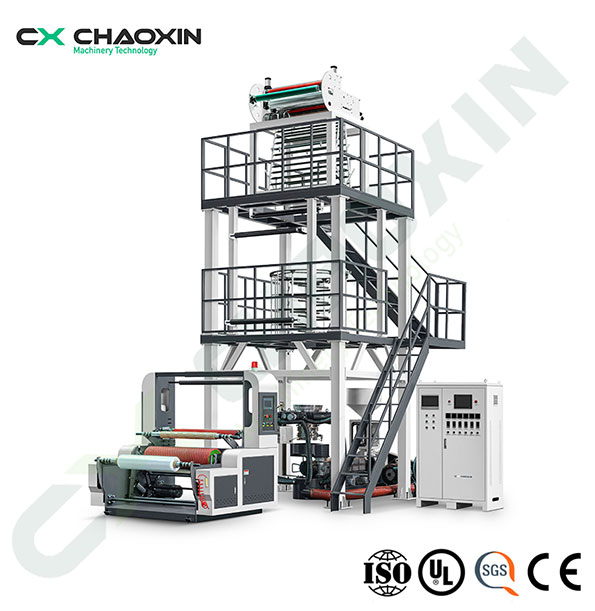
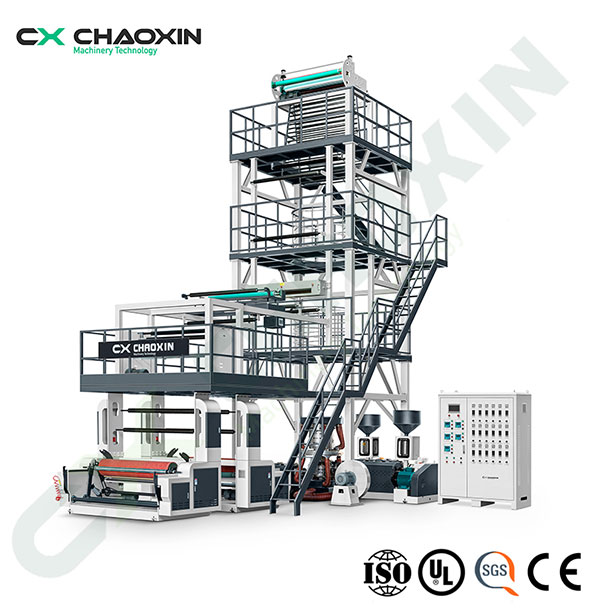
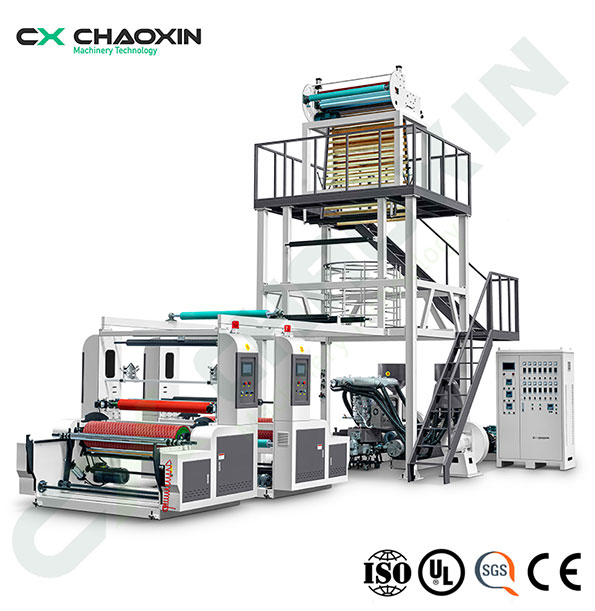
A blown film machine with two extruders feeding a single co‑extrusion die head creates a two‑layer film. The machine can be configured as AB (one material on top, another on the bottom) or ABA (same material on both outer layers, a different material in the core) when equipped with a three‑channel die. This twin‑star design from China Chaoxin runs LDPE, HDPE, and LLDPE, producing film from 0.02mm to 0.15mm thick, with a lay‑flat width of 800‑1500mm. This article explains what twin‑star co‑extrusion means on the production floor, why ABA structure cuts material cost without sacrificing printability, and where the twin‑extruder architecture fits in a flexible packaging line that runs both commodity bags and high‑performance films
A conventional single‑layer blown film line uses one extruder, one screw, one barrel, and one melt stream. The film has the same composition throughout. If you add recycled resin or calcium carbonate filler, it appears on the surface, degrading gloss, printability, and seal strength.
A twin‑star blown film machine uses two independent extruders. The primary extruder (typically larger, φ65‑φ80) supplies the outer layer(s) and core, depending on the die configuration. The secondary extruder (φ50‑φ65) supplies the second layer. The two melt streams combine in a co‑extrusion die head just before the film exits. The die head can be configured as a two‑channel (AB) or three‑channel (ABA) design. The twin‑star name refers to the two extruders working in parallel, each with its own drive, temperature zones, and screw design optimised for its material.
| Extruder Configuration | Number of Extruders | Film Structure | Typical Use |
|---|---|---|---|
| AB (2‑channel die) | 2 | Two different layers | Barrier film, coloured layer + natural layer |
| ABA (3‑channel die) | 2 | Same material on both surfaces, different core | Cost‑optimised bags, recycled core |
| ABC (3 extruders) | 3 | Three different materials | High‑barrier food packaging |
The ABA structure is the most common for commodity flexible packaging. The outer A layers use virgin resin for surface gloss and printability. The inner B layer can be filled with recycled post‑industrial resin, calcium carbonate masterbatch, or lower‑grade material. The twin‑star machine achieves this with only two extruders. In a true three‑layer line, three extruders would be required. The ABA design reduces capital cost and floor space while delivering the same material savings as a three‑extruder line.
In an ABA configuration, the primary extruder supplies both outer layers. The melt is split inside the die into two separate flow channels, one for the top outer layer and one for the bottom outer layer. The secondary extruder supplies the core layer, which is fed into the centre of the die. The three layers merge just before the die lip and exit as a single bubble. The layer distribution is controlled by adjusting the output of each extruder. For a 100‑micron ABA bag with a 60% core thickness, the secondary extruder runs at 60% of the total output; each primary extruder channel runs at 20%.
The ABA structure is the workhorse of flexible packaging for a simple reason: most bags do not need three different materials. They need two good surfaces and a cheap middle. A shopping bag, a garbage liner, an agricultural mulch film — none require the barrier properties that an EVOH or nylon core provides. They do, however, require a glossy, print‑receptive outer layer and a heat‑sealable inner layer. ABA delivers both with only two extruders.
The twin‑star blown film machine from China Chaoxin uses this architecture. The A layers (the two outer surfaces) are supplied by the primary extruder. The B core layer is supplied by the secondary extruder. The core layer can be filled with recycled content or calcium carbonate at percentages up to 50% without compromising the final film’s performance. The outer A layers, each typically 15‑25% of total thickness, provide the mechanical strength and print surface. The bag‘s tear resistance, puncture resistance, and seal strength all derive from those virgin outer layers, while the core simply adds bulk and stiffness.
For a converter processing 1,000 tons of film per year, shifting from single‑layer to ABA co‑extrusion reduces material cost by roughly 15‑20%. The saving comes from replacing expensive virgin resin in the core with recycled material that costs 30‑50% less per kilogram. The outer layers remain 100% virgin, so the bag looks and performs like an all‑virgin bag
Multi‑layer structures distribute stress across the film more evenly. A three‑layer ABA bag will often outperform a single‑layer bag of the same total thickness in puncture and tear testing. The virgin outer layers act as a tough skin, while the filled core adds stiffness without becoming brittle. For a 50‑micron shopping bag, an ABA structure with a 60% recycled core can have higher tensile strength than a 60‑micron single‑layer bag made entirely from virgin resin, allowing converters to downgauge and reduce overall material consumption.
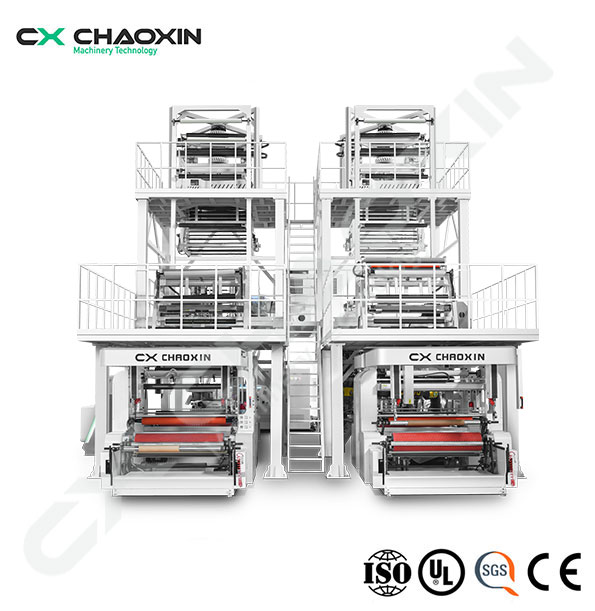
The twin‑star design uses a primary extruder that is typically larger than the secondary extruder. Common configurations:
Primary extruder: φ65‑φ80 screw diameter, 30:1‑32:1 L/D ratio. Supplies the outer layers (both A layers) and, depending on configuration, part of the core.
Secondary extruder: φ50‑φ65 screw diameter, 30:1‑32:1 L/D ratio. Supplies the core layer (B layer) in ABA mode or the second layer in AB mode.
The output ratio between the two extruders determines the layer distribution. For a 20/60/20 ABA split, the primary extruder runs at 40% of total output (20% to each A layer), and the secondary extruder runs at 60% to the B layer. The extruder speeds are controlled independently via the PLC, so the operator can adjust the layer ratio on the fly. For a job that requires a thicker core, the secondary extruder speed is increased; for a job that requires a thicker outer surface, the primary extruder speed is increased.
The maximum output of the twin‑star line depends on the screw diameters. A φ65 primary / φ50 secondary combination can produce roughly 80‑120 kg/h of ABA film at 50‑100 microns. A φ80 primary / φ65 secondary combination can reach 150‑200 kg/h. The output is split between the two extruders according to the target layer ratio, not added together — the total output is determined by the sum of the two extruder outputs, but limited by the cooling capacity of the bubble.
In ABA mode, the primary extruder supplies two layers — the top A layer and the bottom A layer — which together account for 40‑50% of the total film thickness. It must also be capable of operating at a higher output than the secondary extruder if the design requires it. The primary extruder's screw is often 15‑20mm larger in diameter than the secondary extruder's screw to meet this demand. The screw material is 38CrMoAlA alloy steel with nitriding treatment to resist wear when processing recycled material containing contaminants.
The twin‑star blown film machine is designed for the flexible packaging market that converts film into shopping bags, garbage can liners, industrial sacks, and agricultural mulch.
Film width: Lay‑flat width ranges from 800mm to 1500mm, with higher‑capacity models reaching 2000mm. A 1500mm wide film can be slit into two 750mm rolls or three 500mm rolls downstream. A 2000mm line can be split into four 500mm lines for high‑volume bag‑making.
Film thickness: The machine produces film from 0.02mm to 0.15mm. The low end (0.02‑0.04mm) is used for lightweight produce bags, garment covers, and thin liners. The high end (0.08‑0.15mm) is for heavy‑duty shipping sacks, agricultural mulch film, and industrial wrapping. The thickness is controlled by adjusting the haul‑off speed and the output of the extruders. A faster haul‑off stretches the bubble thinner; a slower haul‑off produces thicker film.
Production speed: The line speed is measured at the haul‑off, typically 40‑100 m/min depending on the film thickness and material. Running 0.04mm LDPE, the line can sustain 80‑100 m/min. Running 0.12mm HDPE, the speed drops to 40‑60 m/min because the bubble requires longer cooling time.
| Material | Thickness Range (mm) | Typical Speed (m/min) | Common Application |
|---|---|---|---|
| LDPE | 0.02‑0.10 | 60‑100 | Shopping bags, light liners |
| HDPE | 0.02‑0.08 | 50‑80 | T‑shirt bags, grocery sacks |
| LLDPE | 0.03‑0.15 | 40‑80 | Stretch film, heavy‑duty sacks |
| Mixed recycled | 0.04‑0.12 | 40‑70 | Garbage can liners, industrial film |
Data sourced from industry‑standard blown film line specifications for comparable equipment.
The air ring is designed for strong wind‑gathering effect, providing higher and more uniform cooling efficiency. Consistent cooling across the bubble circumference prevents thickness variation that would cause bag‑making jams downstream.
A blown film machine that runs recycled material requires frequent screen changes. Contaminants in post‑industrial or post‑consumer recycled resin plug the screen pack faster than virgin resin. A manual screen change takes 15‑30 minutes, during which the line stops and the melt cools.
The twin‑star machine is equipped with a hydraulic screen changer. The operator pushes a button, and a hydraulic ram moves the screen pack laterally, bringing a fresh screen into the melt stream while pushing the clogged screen out. The change takes under 30 seconds, and the melt pressure remains stable throughout. Stable melt pressure is critical for bubble formation. A pressure drop during a screen change would cause the bubble to collapse, requiring a complete restart. The hydraulic screen changer prevents that downtime.
The screen changer also includes a melt pressure sensor that alerts the operator when the pressure rises above the setpoint. A pressure increase of 2‑3 MPa over the baseline indicates that the screen pack is clogging. The operator schedules a screen change during a natural production pause rather than waiting for a jam.
The machine also features reliable sealing to prevent material leakage at the screen changer housing. Leakage would cause melted polymer to drip onto the floor, creating a safety hazard and wasting material
.
The bubble is the most vulnerable section of a blown film line. Ambient air currents, thermal asymmetry, or mechanical vibration can introduce bubble oscillation that telegraphs directly into gauge variation.
The twin‑star machine uses a dual‑lip air ring with adjustable air volume. The primary air jet immediately freezes the melt surface as it exits the die. The secondary air flow maintains the bubble diameter and stabilizes the frost line. The air volume is adjustable independently for each quadrant of the air ring. If the bubble tilts to one side, the operator increases air volume on the opposite side to push it back.
The air ring also includes a wind‑gathering skirt that directs airflow directly onto the bubble, preventing ambient drafts from disturbing the film. For a plant located in a drafty building or near loading docks, the wind‑gathering feature is the difference between a stable bubble and a line that stops every 15 minutes [7†L9-L10].
The cooling air is filtered and dehumidified for high‑output lines. Dust in the airstream would land on the melt surface, creating pinholes in the film. For a bag converter running HDPE for produce bags, a pinhole defect will cause the bag to leak when filled with water.
After the bubble is collapsed, the flattened web passes through the haul‑off unit. The haul‑off is a pair of rubber‑covered rollers driven by a servo motor. The speed of the haul‑off determines the final film thickness. The servo motor maintains constant speed even when the rewinder torque fluctuates.
The winder is a surface winder with a lay‑on roller. The lay‑on roller contacts the surface of the finished roll as it builds, applying a controlled radial force that compresses the outer layers against the inner layers, preventing telescoping. The roller is mounted on a pneumatic cylinder that adjusts force as the roll diameter increases, maintaining constant nip pressure from core to full diameter.
For materials that are prone to slippage — such as high‑gloss film or silicone‑coated release liners — the lay‑on roller is essential for producing rolls that unwind cleanly. The winder also includes a friction or servo‑driven rewind option. The friction rewind is simpler and lower cost; the servo‑driven rewind provides constant tension control for thin films.
The machine includes an automatic edge trim slitting station. The operator sets the finished roll width, and the slitting knives cut the excess film from both edges. The edge trim is sucked away by a vacuum system and can be fed directly to a granulator for recycling back into the extruder. For a plant running 100% recycled LDPE in the core layer, the edge trim return reduces material cost by 5‑8%.
The twin‑star blown film line is designed for high‑volume commodity packaging. Typical applications include:
T‑shirt shopping bags: HDPE or HDPE/LLDPE blend at 0.02‑0.03mm thickness, ABA structure with recycled core. The ABA structure hides recycled content in the core while the virgin outer layers provide the crisp feel and printability required for store branding.
Garbage can liners and industrial sacks: LDPE or LLDPE at 0.05‑0.10mm thickness, ABA structure with high filler content (calcium carbonate) in the core. The filler adds stiffness, helping the bag stand open in the can. The outer layers remain flexible enough to tie closed.
Agricultural mulch film: LDPE/LLDPE blend at 0.08‑0.15mm thickness, ABA structure with UV stabilizers and degradation promoters in the core. The A layers protect the additive package from leaching out while maintaining the film‘s mechanical integrity during field installation.
Industrial packaging and shrink wrap: LLDPE at 0.05‑0.12mm thickness, AB structure for clarity and puncture resistance. The two‑layer design allows one layer to be formulated for cling, the other for strength.
The machine runs a full range of polyolefin films: LDPE for clear garment bags and produce roll bags; HDPE for stiff, opaque merchandise bags; LLDPE for stretchable bags requiring high puncture resistance; and blends of all three for balanced properties.
Yes. The operator can shut off the secondary extruder and run the primary extruder alone, producing single‑layer film through the same die. However, the die is designed for co‑extrusion, so the single‑layer output may be slightly lower than a dedicated mono‑layer line because the die geometry is optimized for combining layers. For a converter who runs mostly ABA but occasionally needs single‑layer, the twin‑star machine offers flexibility without a second machine.
The twin‑star machine produces two‑layer AB or three‑layer ABA film. AB is used when two different properties are required on each side — for example, a cling layer on the inside and a slip layer on the outside for stretch wrap. ABA is used when the surface properties must be the same on both sides, but the core can be different — the standard for shopping bags and garbage can liners. True three‑layer ABC (three different materials) requires three extruders, not two.
No. The total output is limited by the die capacity and the cooling capacity of the bubble, not by the number of extruders. A twin‑star machine running ABA produces roughly the same total kilograms per hour as a single‑layer machine of the same die diameter. The advantage is not higher output; it is lower material cost per kilogram and improved film properties. The ability to put recycled material in the core while keeping virgin material on the surfaces reduces the per‑kilogram cost of the finished film by 15‑20% compared to an all‑virgin single‑layer film.
The co‑extrusion die head has separate flow channels for each layer. Changing from LDPE to HDPE or from one colour to another requires purging the die. The twin‑star machine uses a purge valve that allows the operator to divert the melt stream to waste while the new material is introduced. The purge time depends on the die size; a 300‑400mm die may take 20‑30 minutes to fully purge. For converters who change materials frequently, scheduling runs by material family (all LDPE jobs together, then all HDPE jobs together) reduces purge waste.
【Request a quote from China Chaoxin】
Contact Chaoxin with your target film width (800‑2000mm), daily output in kilograms, and whether you plan to use recycled material in the core for an ABA line configuration and a hydraulic screen changer recommendation.
ZHEJIANG CHAOXIN MACHINERY TECHNOLOGY CO., LTD.
Booth No:12859
Time: September 28 – October 2, 2026
Add: Carrera 37 No 24. 67 Bogotá Colombia
Exhibition Hall:Centro Internacional de Negocios y Exposiciones de Bogotá (Corferias)
WEB: www.zjchaoxin.com





 English
 Pусский
 Español