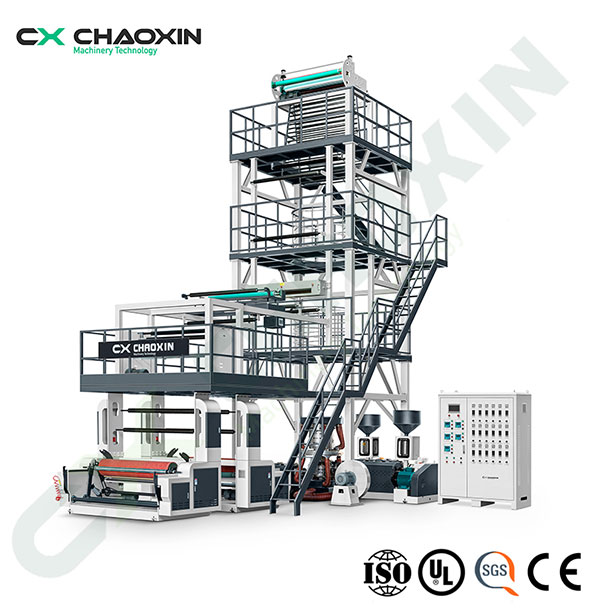
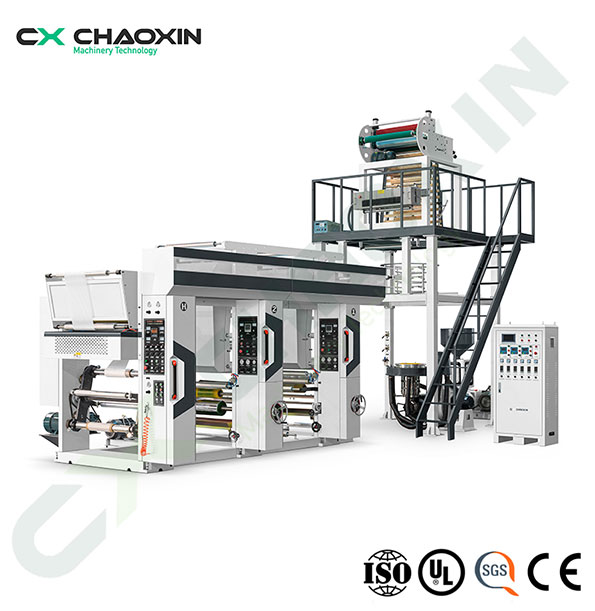
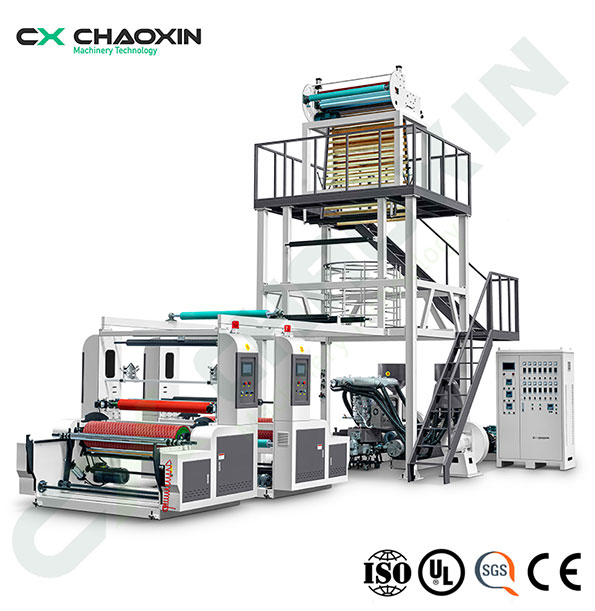
Buying Your First Machine?
Call +86-13958915221
Walk through any blown film plant, and you’ll see the same rhythm: pellets disappear into the extruder, rolls of film stack up at the winder. But after a few years, some lines still hum along at peak efficiency while others turn into money pits. The difference isn’t luck. It’s in the engineering choices that don’t make it into a glossy brochure. Five‑roller traction instead of three. Double alloy screws with 30:1 or 32:1 L/D ratios. Motors and drives from ABB, Siemens, or Brook. And a warranty that doesn’t stop at 12 months. A blown film machine that gets those details right will pay you back shift after shift. This guide cuts through the marketing noise and focuses on the specs that actually move the needle – using real data from a manufacturer that runs 6S management and backs its core components with a three‑year warranty.
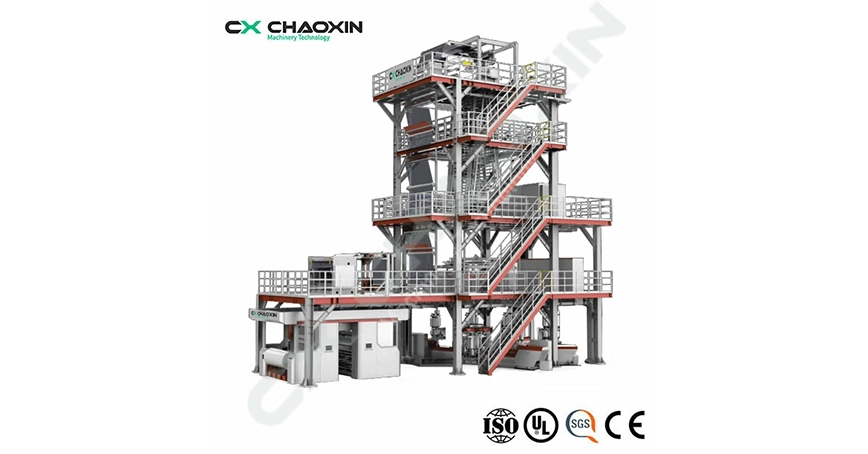
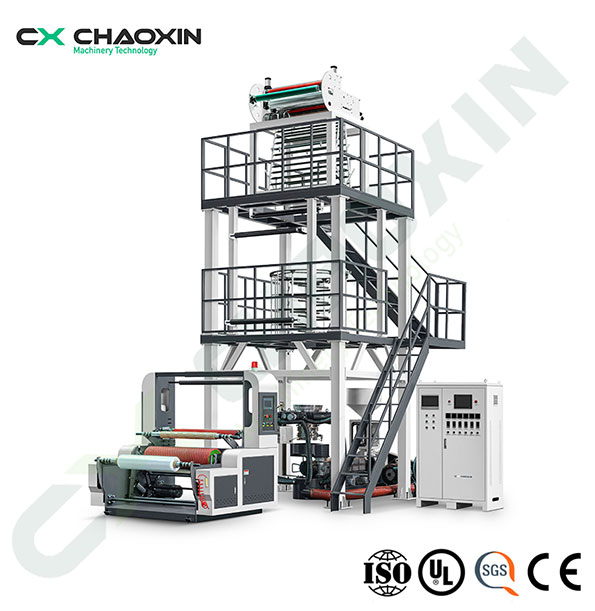
Every blown film line follows the same four steps. The quality of each step depends on the machine’s design – not the brochure.
Plastic pellets are fed into the extruder barrel. A rotating screw pushes them forward while heaters melt the resin. The screw’s design – length, compression ratio, alloy composition – determines how uniformly the melt is mixed. Poor mixing leaves unmelted “crystal points” that ruin optical clarity and weaken seals. I’ve seen converters reject entire rolls because of crystal points that a cheap screw left behind.
Melted plastic exits through a circular die. Air blown into the center expands the plastic into a bubble. Air rings cool the bubble from the outside. The cooling rate and air pressure directly affect film thickness, clarity, and mechanical strength. Inconsistent cooling creates weak spots that tear during bag making. A stable bubble is the difference between a roll that runs and one that jams.
The bubble collapses between nip rollers into a flat tube. The number and alignment of these rollers affect how flat the film remains. More rollers (five vs. three) mean better control and fewer wrinkles. Wrinkled film doesn’t just look bad – it fails in printing and bag making.
The flattened film is wound into rolls. If tension is inconsistent, the roll telescopes or develops hard spots. Patented winding systems with multi‑mode options handle different film gauges and roll diameters without defects. A bad roll can’t be fed into a bag machine – it becomes scrap.
Most blown film lines use three or four haul‑off rollers. One manufacturer’s industry‑first five‑roller design provides three clear advantages.
Each additional roller helps flatten the bubble more gradually. With five rollers, the film passes through multiple nips, reducing the risk of wrinkles that can appear with fewer rollers. In a side‑by‑side test, a five‑roller line produced 40% fewer rejects in downstream bag making.
Tension fluctuations cause bag‑making problems downstream. The five‑roller system distributes tension evenly across the film width, preventing edge waves or center sag. Operators can walk away and trust the line.
Because the film is better controlled, the line can run at higher speeds without sacrificing quality. For a given output target, you might be able to run a smaller die or lower melt temperature – saving energy.
A line with five‑roller traction produces flatter film, which translates to fewer rejects in bag making or printing.
The screw is the most critical component in any extruder. One manufacturer uses self‑developed 30:1 and 32:1 double alloy screws.
Double alloy screws are made from two different metal alloys – typically a wear‑resistant alloy at the feed section and a corrosion‑resistant alloy at the metering section. This extends screw life when processing recycled materials or additives. I’ve seen screws wear out in 18 months on recycled material; double alloy lasts 5‑7 years.
Length‑to‑diameter (L/D) ratio determines how long the material stays in the barrel. Longer screws (32:1 vs. 24:1) provide more mixing stages, better melting, and lower melt temperature. The result is fewer crystal points and more uniform thickness. For high‑output lines, 32:1 is becoming the standard.
Biodegradable resins (PLA, PBAT) have different processing windows. The double alloy screw design allows for tighter temperature control and reduced shear, preventing degradation. If you’re moving into compostable films, this matters.
One manufacturer assembles its machines using globally recognized brands: ABB, Omron, Schneider, GE, Siemens, Brook.
When a component fails, you need a replacement fast. International brands have global distribution networks. You won’t wait weeks for a generic part from an unknown supplier. A plant in Vietnam lost three weeks of production waiting for a no‑name drive – that’s a cost you can’t recover.
ABB and Schneider inverters provide accurate speed control for the extruder and haul‑off. Omron temperature modules maintain ±1°C accuracy. Siemens and GE motors offer high efficiency and long life. These aren’t marketing names – they’re proven components.
If you have other machines using the same brands, you can keep fewer spare parts. Standardization reduces inventory costs. One plant standardized on ABB drives across 12 lines and cut their spare parts inventory by 60%.
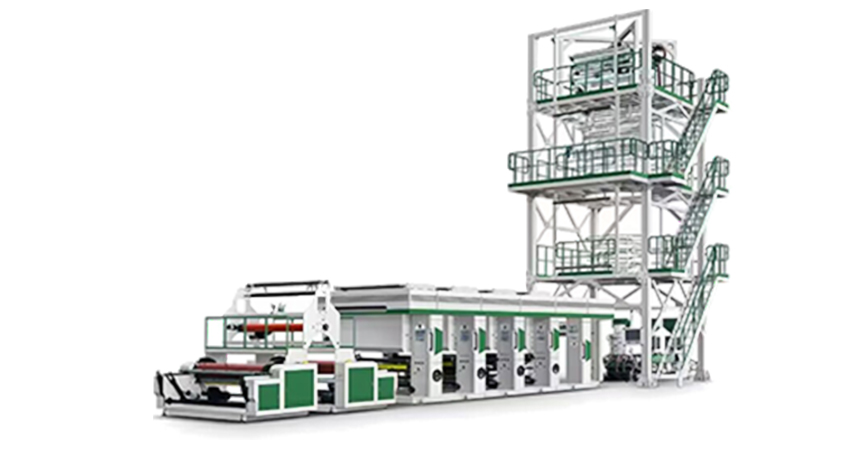
6S is a workplace organization method that originated in Japan. It stands for Sort, Set in order, Shine, Standardize, Sustain, Safety.
A factory that practices 6S is clean, organized, and disciplined. Assembly errors are less common because tools and parts have designated places. Quality checks are standardized. The result is a machine that arrives with fewer loose bolts, misaligned components, or contamination in the oil system. I’ve visited plants where the difference between a 6S factory and a messy one is night and day – the machines from the 6S plant simply work out of the crate.
Chaoxin has implemented complete 6S standards across its production floor. This is not a marketing badge – it’s a daily practice that shows up in the fit and finish of every blown film machine they ship.
Film extrusion is energy‑intensive. A typical line running 24/7 can consume 100‑200 kW. Even a 5% reduction saves thousands of dollars per year.
PID temperature controllers minimize overshoot. Instead of heaters running at full power then shutting off, they modulate to maintain exact temperature. This reduces energy waste and prevents degradation.
Better insulation means less heat loss to the room. Barrel covers designed for easy removal but high thermal efficiency can cut energy use by 8‑12%.
Five‑roller traction and high‑efficiency motors reduce mechanical losses. Less energy turns into heat; more turns into film.
Most blown film manufacturers offer a 12‑month warranty. One manufacturer gives three years on core components.
The warranty typically covers the screw, barrel, gearbox, and main drive motor. These are the most expensive parts to replace – a screw alone can cost $20,000.
A longer warranty means the manufacturer uses higher‑grade materials and has confidence in their assembly. It also gives you budget predictability – you won’t face a $20,000 screw replacement in year two. That’s real peace of mind.
A blown film machine with a three‑year core warranty lowers your total cost of ownership.
Chaoxin’s blown film lines are used in four main sectors. Each requires different screw profiles and cooling setups.
| Application | Key requirement | Why this line fits |
|---|---|---|
| Food packaging | Optical clarity, seal strength | Double alloy screw eliminates crystal points |
| Agricultural films | UV stability, thickness uniformity | Five‑roller traction ensures even gauge |
| Industrial packaging | Tear resistance, consistent gauge | High‑efficiency drives, robust winding |
| Compostable films | Low shear, tight temperature control | Double alloy screw with biodegradable tuning |
Each application may need different screw profiles, die gaps, or air ring configurations. One manufacturer’s self‑developed screws can be customized.
When you buy a line, you’re not just getting a machine.
Technicians assist with setup and alignment. They don’t just drop off the machine and leave.
On‑site training continues until your team can run the line independently. I’ve seen suppliers do a two‑day training and disappear – that’s not enough. Chaoxin stays until you’re comfortable.
For control system issues, technicians can connect remotely to troubleshoot. This saves days of waiting for a service visit.
Their subsidiary, Zhejiang Chaozheng Import and Export Trading Co., Ltd. (established in 2023), handles export logistics, making shipping and customs clearance smoother for international buyers.
Instead of a standard FAQ, here are answers to what buyers actually ask.
Can I run recycled pellets?
Yes, but you need a screw design that handles contamination. Double alloy screws are more wear‑resistant, making them suitable for recycled materials.
What’s the typical lead time?
Standard models ship in 60‑90 days. Fast‑track service is available for urgent orders – I’ve seen 18‑day delivery for customers who needed it.
Do you provide spare parts?
Yes. Wearing parts – screws, barrels, seals, heaters – are stocked and shipped globally. No waiting months for a custom part.
Is the machine CE certified?
Yes. Machines meet CE safety standards, required for European markets.
How do these lines compare to alternatives?
Compared to European brands
European lines are excellent but often cost 40‑60% more and have lead times of 6‑9 months. Chaoxin’s 60‑90 day lead time and lower price point make them competitive – not inferior.
Compared to low‑cost Asian lines
Cheaper lines may use generic screws and three‑roller traction. They might save you money upfront, but the reject rate and downtime will cost you later. Chaoxin’s five‑roller and double alloy screw are standard, not upgrades.
Compared to used equipment
Used lines are a gamble. You don’t know the screw wear or gearbox condition. A three‑year warranty on a new line is worth more than a 50% discount on a used machine with unknown history.
You don’t need to spec a machine just from a web page. One manufacturer offers a free catalog that details screw configurations, winding options, and energy performance data.
A blown film machine (third mention) built with five rollers, double alloy screws, international drives, and a three‑year warranty is a long‑term asset. Chaoxin delivers all of that with 6S discipline.
ZHEJIANG CHAOXIN MACHINERY TECHNOLOGY CO., LTD.
Booth No:R26
Time: October 8–10, 2026
Add: Seashell Lane, Mall of Asia Complex, Pasay City, Philippines
Exhibition Hall:SMX CONVENTION CENTER MANILA
WEB: www.zjchaoxin.com





 English
 Pусский
 Español