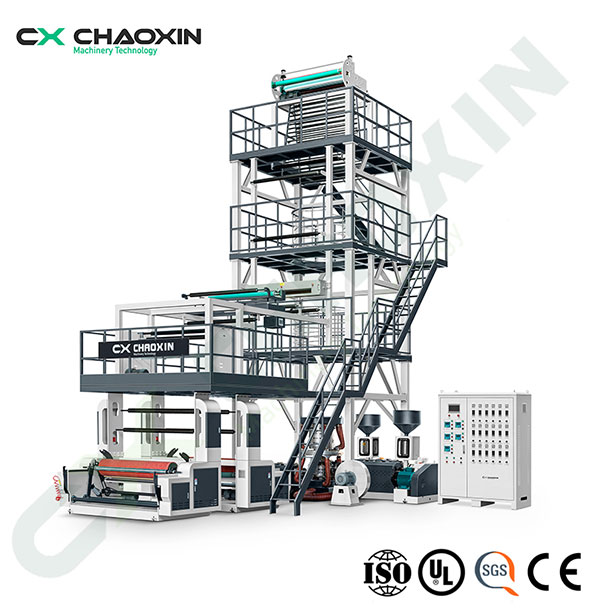
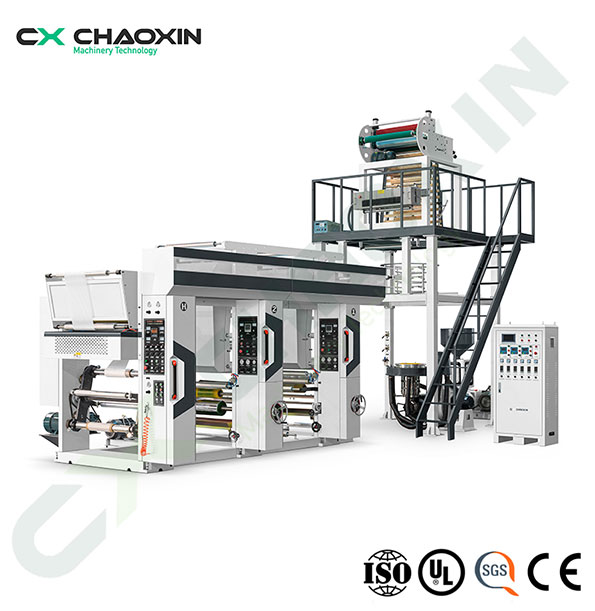
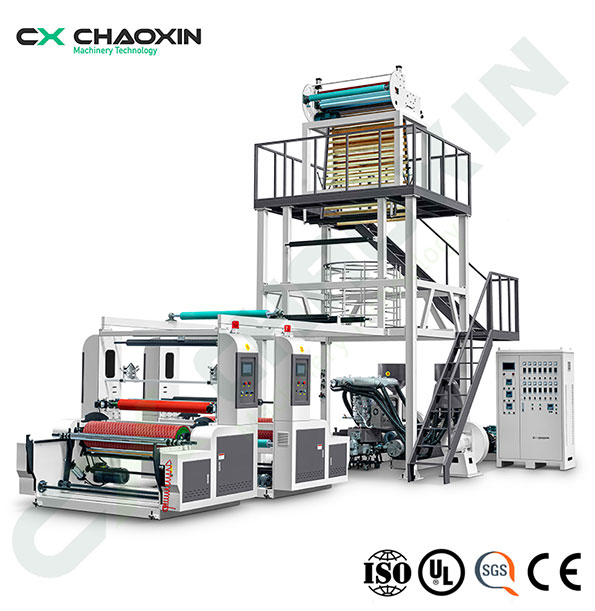
Buying Your First Machine?
Call +86-13958915221
You’ve got the order for printed film – snack bags, shrink sleeves, stand‑up pouches. The artwork is approved. The substrate is ordered. Now you need a printing machine that won’t turn your first production run into a pile of misregistered waste. Walk into any printing plant, and you’ll hear the same complaints: colors that won’t stay aligned when you speed up, ink that doesn’t dry fast enough, film that stretches and wrinkles. This guide skips the brochure language and focuses on three real‑world subsystems: tension control, register accuracy, and drying efficiency. We’ll look at what actually causes those mid‑run failures – and what to ask before you sign the purchase order.
A roll of plain film enters one end; a roll of printed film comes out the other. Between those two points, the film passes through four critical zones. Any weakness in one zone ruins the whole job.
The roll sits on an unwinder. As the diameter shrinks, the weight changes. Without active tension control, the film will either snap or go slack. A reliable press uses a load cell or a dancer roller to measure tension and adjusts the brake or motor every millisecond. I’ve seen plants lose hours of production because the unwind brake was set manually – and the operator didn’t notice the tension creep until the film stretched beyond recovery.
Each color has its own station. The film wraps around a central impression drum or travels between individual units. At each station, an anilox roller meters ink onto a plate, which transfers the image to the film. The gap between stations must be precisely timed so each color lands exactly on top of the previous one. If the timing is off by even a few milliseconds, the label looks fuzzy – and you won’t know until you’ve run 500 meters.
Before the film reaches the next color, the ink must be dry or cured. Solvent‑based inks need hot air to evaporate solvents. Water‑based inks need warm, high‑velocity air. UV inks cure instantly under ultraviolet lamps. If drying is incomplete, the next station smears the previous color. I recall a converter who spent three months troubleshooting smearing – only to discover the dryer nozzles were clogged with dust.
The printed film winds back into a roll. If tension is wrong, the roll telescopes or develops hard spots. An inspection station or camera system checks for defects before the roll leaves the machine. A press that handles these four zones well will run for years with minimal scrap.
You can’t see tension fluctuations with your eyes, but you’ll see their effects: stretched print, wrinkled edges, broken film.
Open‑loop tension uses a fixed torque. As the roll diameter changes, tension changes – and your print elongates. Closed‑loop uses sensors to measure actual tension and adjusts motor torque continuously. All modern industrial printers use closed‑loop. The ones that don’t? They’re usually older machines or entry‑level units. I’ve seen a plant save $15,000 per year in waste just by retrofitting a closed‑loop tension system.
A dancer roller is a moving idler that acts as a shock absorber. When the unwind jerks, the dancer moves to keep tension steady. Without dancers, every small disturbance transfers directly to the print. One manufacturer includes dancers at the unwind, between print stations, and at the rewind – overkill? Not if you run high‑value substrates.
| Problem | What causes it | What it ruins |
|---|---|---|
| Stretched film | Too much tension | Print elongation, color mismatch |
| Wrinkled film | Uneven tension | Ink skipping, edge damage |
| Telescoped roll | Poor rewind tension | Can’t feed into bag machine |
A press with closed‑loop tension control prevents these issues. Without it, you’re gambling every shift.
Register is the alignment of each color to the others. If the magenta plate prints 0.2mm off from the yellow, the label looks fuzzy – and your customer rejects the whole batch.
Print registration marks (small targets) are printed with each color. A camera reads these marks and sends signals to the controller. The controller adjusts the plate position electronically. The key question: how fast can the controller respond? Cheap systems take several revolutions to correct. Good systems correct within one revolution.
Older presses use a mechanical line shaft – one motor drives all stations through gears. To change print length, you manually adjust gears – a process that can take hours. Newer presses use an electronic line shaft – each station has its own servo motor, and a central controller synchronizes them. Change the print length on the HMI, and all stations move together in seconds.
If you run many different print lengths, an electronic line shaft saves hours of setup time. You can store recipes for repeat jobs. One manufacturer uses ABB and Schneider drives with Omron controls – the same components as their blown film lines. That cross‑pollination matters because they’ve already debugged the system in thousands of extrusion lines.
The fastest printing press in the world is useless if the ink doesn’t dry before the next station.
For solvent‑based and water‑based inks, hot air nozzles blow onto the film after each station. The air temperature and velocity must be uniform across the web width. If the nozzles are clogged or the temperature varies by ±10°C, you get incomplete drying or scorched film. Energy‑optimized dryers with recirculation reduce heat loss by 30‑40%.
UV inks cure instantly under ultraviolet lamps. This allows very high speeds and zero solvent emissions. However, UV lamps generate heat and consume power. LED UV lamps are more efficient but cost more upfront. The choice depends on your ink chemistry and substrate sensitivity.
The distance between print stations determines how long the film has to dry. For high speeds, longer tunnels or more efficient nozzles are needed. Some presses add extra drying modules between colors – a sign that the manufacturer has thought about real‑world throughput, not just brochure numbers.
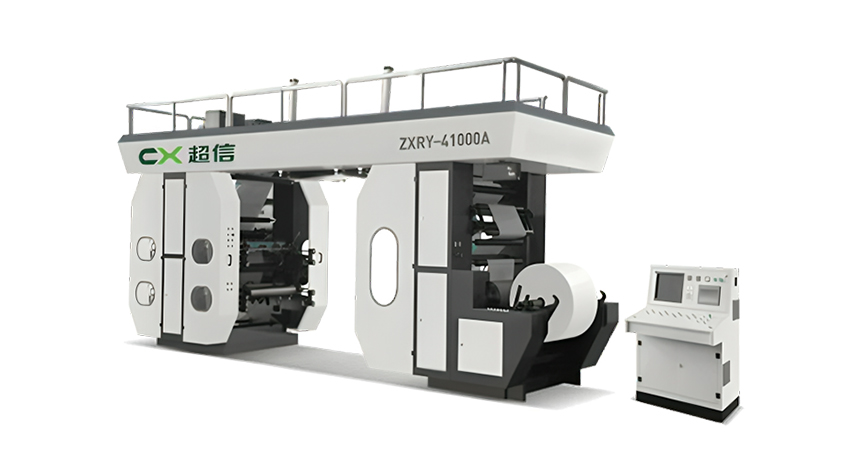
You might know them for blown film lines, but the same company – Chaoxin – also builds printing machines for flexible packaging. Their approach mirrors their extrusion equipment: 6S management, international components (ABB, Omron, Schneider, Siemens), and a three‑year warranty on core components – uncommon in printing.
The production of a Chaoxin printing machine is a complex process, but the result is equipment designed for the printing industry, not adapted from something else.
Number of colors: 4 to 12
Web width: 600mm to 1200mm
Drying type: hot air, UV, or combination
Automatic register control
Inline slitting or rewinding
A printing machine with these features gives you flexibility to run short runs or long runs with minimal waste.
A printing machine is not plug‑and‑play. It needs proper installation, calibration, and training.
Leveling the press frame
Aligning print stations to the common impression drum
Setting up tension profiles for your substrates
Calibrating register cameras
I’ve seen a $500,000 press underperform because the operators didn’t know how to set the register cameras correctly. Chaoxin provides on‑site training until your team can run the press independently. Topics include: loading and aligning plates, adjusting doctor blades, setting drying temperatures, and troubleshooting common issues.
Chaoxin stocks wearing parts: doctor blades, anilox rollers, sleeve adapters, heaters, and temperature sensors. Downtime waiting for a $50 part is expensive – make sure your supplier has a local or fast‑ship warehouse.
Instead of trusting the brochure, ask these five questions:
What’s the register accuracy at full speed? Look for ±0.1mm or better.
Can you store recipes for repeat jobs? Saves setup time.
What brands are the drives and controls? ABB, Omron, Siemens are good signs.
How long is the warranty on core components? Three years is rare but valuable.
Do you have a test facility? Run your own film and ink before ordering.
If the supplier hesitates or gives vague answers, they’re hiding weaknesses.
How do these presses compare to alternatives?
Compared to European‑built presses
European machines are precise, well‑built, and expensive. Lead times of 6‑9 months are common. Chaoxin’s lead time is 60‑90 days, with an 18‑day fast‑track option. Both have their place – the choice depends on your timeline.
Compared to lower‑priced Asian suppliers
Some Asian presses offer competitive pricing but may lack after‑sales support. Chaoxin stocks spares and provides on‑site training. That’s not to say others are unreliable – just verify support before ordering.
Compared to used presses
Used equipment can be cost‑effective, but you inherit unknown wear on bearings, cylinders, and electronics. Chaoxin’s three‑year warranty on core components gives you peace of mind that a used machine cannot.
You don’t have to commit based on a datasheet. Chaoxin can arrange a test run using your film, your inks, and your artwork. See the register accuracy, check the drying efficiency, and inspect the finished rolls.
A printing machine that holds register, dries quickly, and keeps tension steady will pay for itself in reduced waste and faster turnaround. One manufacturer delivers that with 6S discipline.
【Contact Chaoxin for a test run】
ZHEJIANG CHAOXIN MACHINERY TECHNOLOGY CO., LTD.
Booth No:R26
Time: October 8–10, 2026
Add: Seashell Lane, Mall of Asia Complex, Pasay City, Philippines
Exhibition Hall:SMX CONVENTION CENTER MANILA
WEB: www.zjchaoxin.com





 English
 Pусский
 Español