Buying Your First Machine?
Call +86-13958915221
A roll of film that varies in thickness from edge to edge is a costly problem. Uneven gauge wastes raw material, creates tension variations during winding, and makes downstream printing or bag‑making unreliable. On an ABA Blown Film Machine, the symptom often points to one of six specific causes—each with a practical fix that doesn‘t require shutting down the line for hours. This guide organizes those causes by where they live: the die head, the cooling system, the extruders, and the materials themselves. Before you start adjusting bolts randomly, learn to read what the film is telling you.
Not all thickness problems look the same. Identifying the visual pattern narrows down the possible causes significantly.
One side thicker than the other (single‑side thick). The film consistently measures thicker on the left or right edge. This often points to a die lip gap that‘s wider on one side or a cooling air ring that’s not centered over the die.
Spiral‑shaped thick bands (helical variation). Thicker areas spiral around the bubble circumference. This usually means the die lip has debris trapped in one spot, or one zone of the die heater is out of calibration.
Random thick‑thin patches. The film shows inconsistent gauge with no repeating pattern. Likely culprits include contaminants in the melt flow, unstable bubble oscillation, or a failing heater that cycles on and off unpredictably.
Die lip misalignment or contamination. The die lip gap directly determines how much material exits each point around the die circumference. If the gap is uneven, so is the film. Over time, degraded polymer can stick to the die lip, creating a local obstruction that thins the film at that spot. Clean the die lips thoroughly with a soft copper blade—never steel—to avoid scratching the surface. Use a feeler gauge to measure the gap at multiple points around the die. The measured gaps should be identical within a few hundredths of a millimeter. Uneven melt temperature across the die circumference. Each heating zone on the die should maintain the same temperature. If one heater band fails or a thermocouple reads inaccurately, that segment of the die will run cooler or hotter, changing the melt viscosity. Lower viscosity flows faster, creating a thicker film at that point. Check all zone temperatures against the controller readings using a contact thermometer. Replace any heater band that doesn‘t reach setpoint or fluctuates more than ±5°C.
Air ring lip gap not concentric with the die. The air ring directs cooling air onto the bubble. If the air ring isn’t centered over the die, one side of the bubble cools faster than the other. Faster cooling freezes the film sooner, reducing draw‑down and producing a thicker section on that side. Loosen the air ring mounting bolts and recenter it using a thickness gauge. The gap between the air ring lip and the die lip should be consistent at every point around the circumference.
Uneven air flow around the bubble. Dust, debris, or plastic fines can partially block the air ring‘s discharge slots. This creates uneven cooling and causes the bubble to oscillate or drift—leading to random thickness variation. Remove the air ring and clean all air passages with compressed air. Verify that the blower fan runs smoothly without vibration. An unbalanced blower motor will pulse air flow, creating periodic thick spots.
Output mismatch between A layers and B core layer. In an ABA configuration, the two A layers (surface layers) are fed by the same extruder (or two synchronized extruders), while the B core layer comes from a separate extruder. If the two A‑layer extruders are not running at the same speed, the layer distribution will vary across the film width. One side of the film may have a thicker A layer than the other, causing the overall gauge to shift. Check the rotational speeds of both A‑layer extruders. They should match within 1–2 RPM. Most modern controllers allow you to view both speeds simultaneously. If they drift apart, recalibrate the drive parameters or check for worn belts in mechanical drive systems. Inconsistent melt temperature from the B extruder. The B core layer often contains recycled material or calcium carbonate filler. These additives change the melt behavior. If the B extruder temperature is too low, the filler won‘t disperse evenly, creating localized thick spots. If it’s too high, the resin degrades, changing viscosity unpredictably. Verify that the B extruder temperature profile matches the recommendations for your specific compound. For highly filled compounds (e.g., 30–50% CaCO₃), run the B extruder 10–20°C hotter than standard LDPE to ensure proper filler dispersion.
Why does thickness variation get worse at higher line speed? Faster draw‑down magnifies any unevenness in melt flow or cooling. If the die lip gap has a small deviation, running at 60 m/min might produce acceptable film, but running at 120 m/min will expose it. When tuning for high speed, start with a perfectly uniform die gap and centered air ring. Also confirm that the cooling air volume is sufficient for the faster throughput—inadequate cooling causes the freeze line to rise, making the bubble unstable.
Can the resin lot cause thickness issues? Yes. A change in melt flow index or additive package can alter how the material behaves in the die. Always run a test roll when switching to a new resin batch. Check the thickness profile at the start of the roll and again after 500 meters. If the variation appears only after changing lots but the machine setup hasn’t moved, the resin is the likely cause.
How often should I measure die gap? In continuous production, measure die lip gap once per week. After cleaning the die, always remeasure and adjust. In high‑output lines running filled compounds, check daily—abrasive fillers can erode die lips over time, changing the gap profile.
Is it normal that the left side is always thinner than the right? No. A persistent side‑to‑side difference indicates a mechanical misalignment. Check the die leveling first—the die head must be perfectly horizontal. Then verify that the air ring is centered. If both are correct, inspect the die internal flow channels for partial blockage on the thin side.
Use this checklist when you encounter thickness variation. Run through it in order—the problem usually lies in the first or second check. Check die lip gap. Use a feeler gauge at 8 to 12 points around the die. Any deviation >0.05mm needs adjustment. Clean die lips and internal channels. Remove visible debris; blow out with compressed air during die disassembly. Verify die zone temperatures. All zones should be within ±3°C of setpoint. Replace any heater that cycles on/off too frequently. Center the air ring. Measure the gap between air ring lip and die lip at four points 90° apart. They should match within 0.5mm. Check A‑layer extruder speeds. Compare the two A extruder speeds at the control panel. They must be synchronized within 1–2 RPM. Stabilize the bubble. Increase cooling air slightly or adjust IBC settings to stop bubble sway.
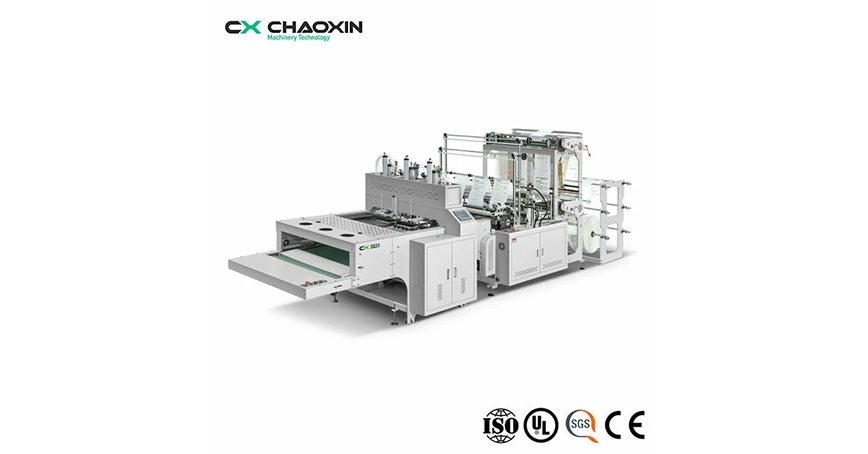
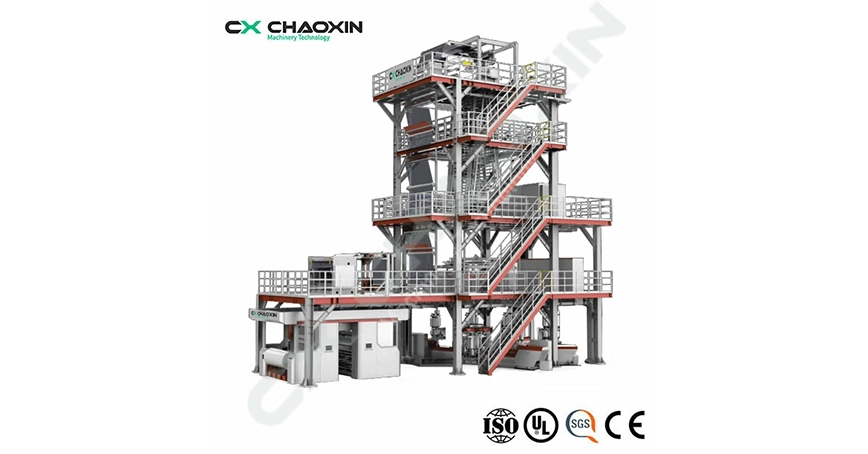
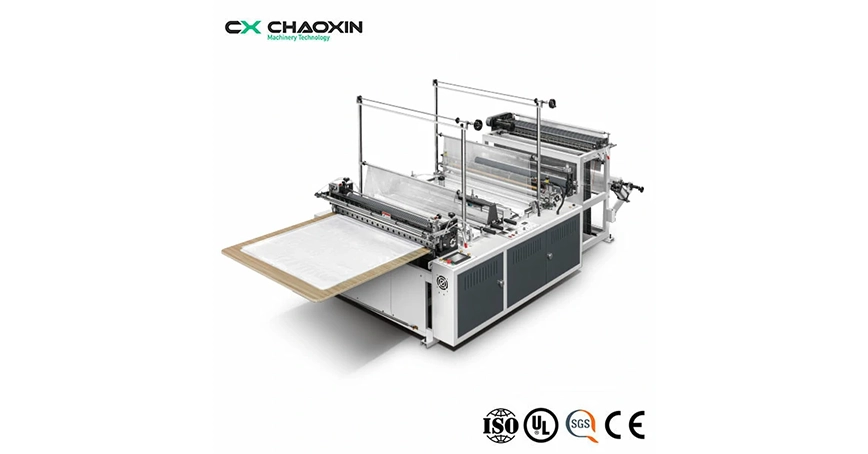
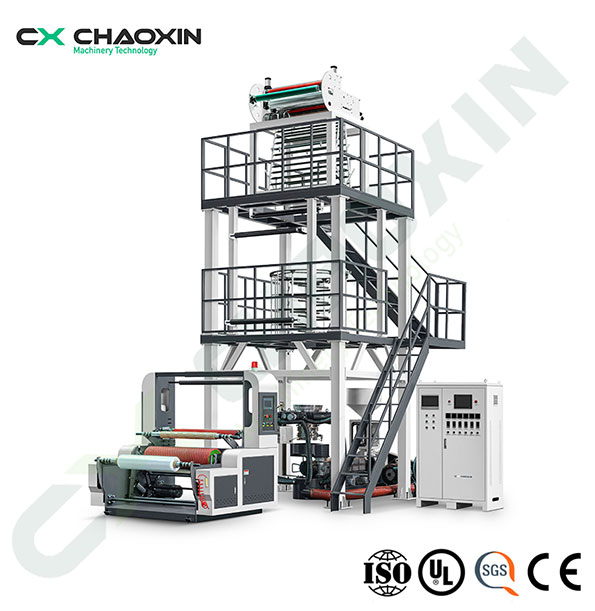
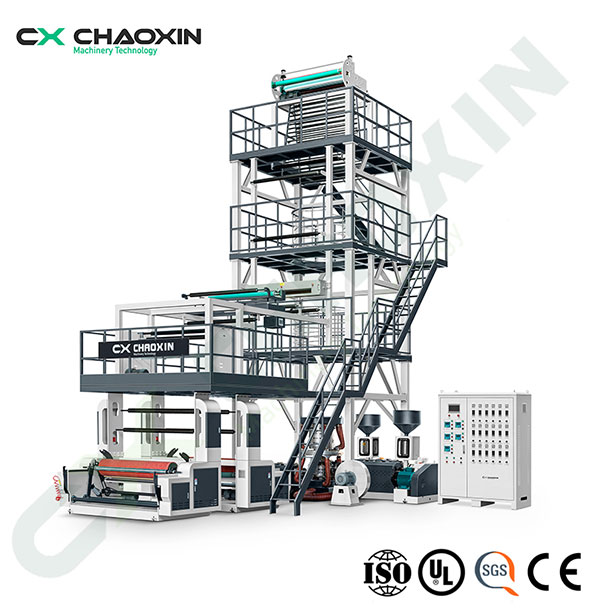
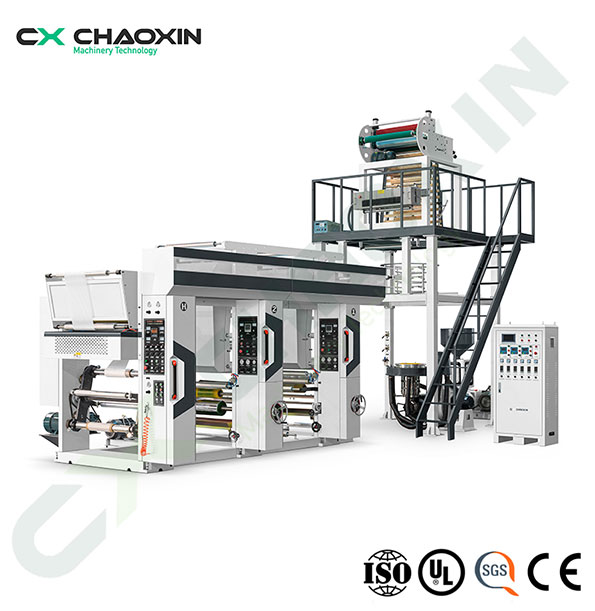
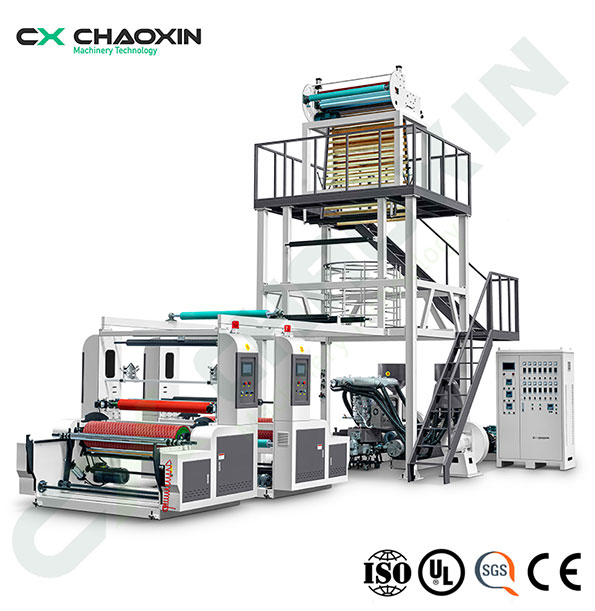
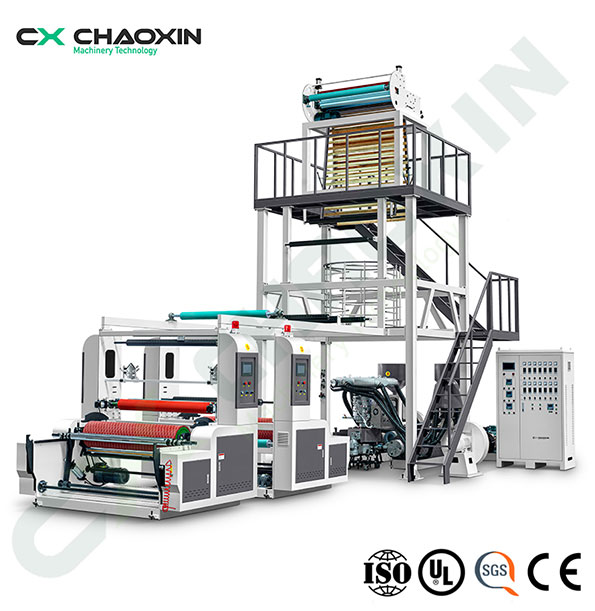
The LDPE/HDPE Automatic ABA Film Extrusion Machine from Chaoxin (Zhejiang Chaoxin Machinery Technology Co., Ltd.) is designed for production environments where film uniformity is non‑negotiable. The ABA co‑extrusion structure allows recycled material to be placed in the center layer without affecting the surface quality of the finished film. The A layers use reinforced or functional materials that provide strength, gloss, and printability, while the B core layer reduces material cost by accepting recycled content and mineral fillers such as calcium carbonate, mica, glass microbeads, silica, and aluminum powder. Typical filler addition ranges are: CaCO₃ 5–40%, mica 1–10%, glass beads 1–15%, silica 1–10%, aluminum powder 1–10%, and polymer masterbatch 1–30%. The machine produces film thickness from 0.006 to 0.10mm, with outputs ranging from 120 kg/h to 400 kg/h depending on the model. The CX‑ABA‑1400 model, for example, uses screw diameters of 55mm, 65mm, and 55mm, producing up to 400 kg/h at 1200mm width. Compared to traditional single‑layer machines, the ABA three‑layer design achieves the same thickness and strength with less raw material, effectively reducing material costs. Compared to ABC three‑layer machines, ABA is also more economical because it uses one fewer extruder. The company, founded in Zhejiang Province, exhibited at CHINAPLAS 2026, one of the world‘s largest plastics trade fairs. Their product range includes mono‑layer, biodegradable, ABA, ABC, AB two‑layer, twin‑head, and multi‑layer co‑extrusion blown film machines, as well as bag‑making machines and printing equipment.
An ABA Blown Film Machine running at its best produces film that is uniform, printable, and cost‑effective. Thickness variation is not inevitable—it has known causes, and each cause has a known fix. Build the checklist into your shift startup routine. Train operators to recognize the visual pattern of each failure mode. Most importantly, when a roll shows uneven gauge, diagnose before you adjust. One die lip bolt turned the wrong way can turn a simple problem into a much more expensive one.
→ Request a quote from Chaoxin for the LDPE/HDPE Automatic ABA Film Extrusion Machine — Share your target film width, thickness range, and output requirements. Their technical team will recommend the right model and screw configuration for your production line.
ZHEJIANG CHAOXIN MACHINERY TECHNOLOGY CO., LTD.
Booth No:R26
Time: October 8–10, 2026
Add: Seashell Lane, Mall of Asia Complex, Pasay City, Philippines
Exhibition Hall:SMX CONVENTION CENTER MANILA
WEB: www.zjchaoxin.com





 English
 Pусский
 Español