Buying Your First Machine?
Call +86-13958915221
You’re running a film plant with a mix of orders — 600mm agricultural film one day, 300mm garbage bags the next. Buying a second machine for the smaller runs doesn‘t make financial sense. Running them sequentially ties up production time. There has to be a way to produce two different widths at the same time.
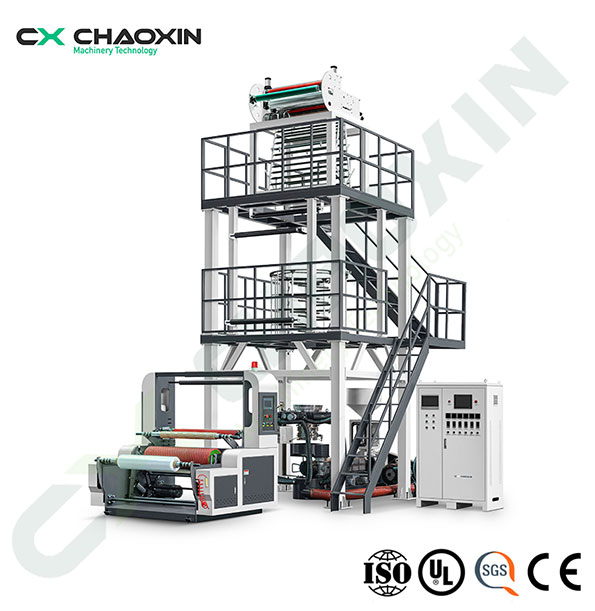
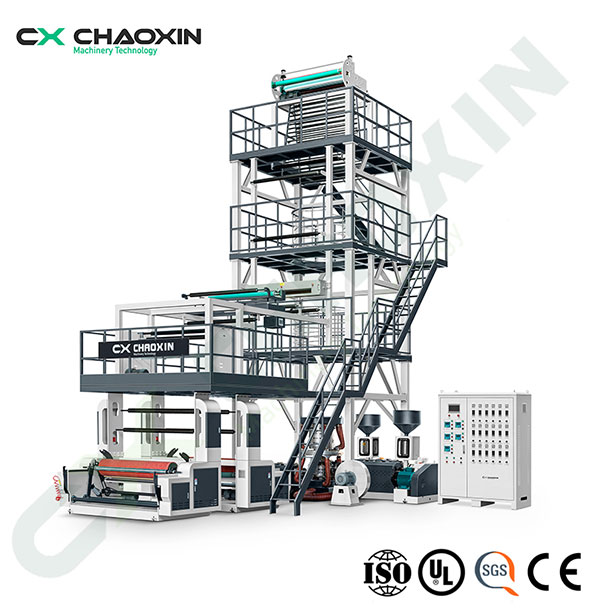
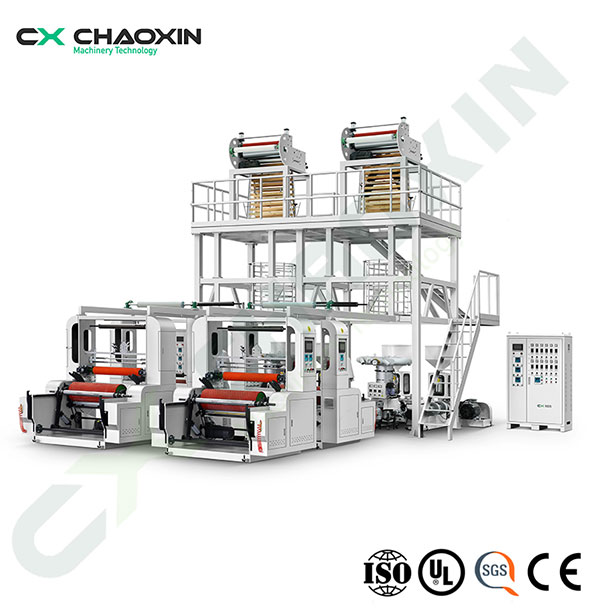
A single screw double die head film blowing machine is that way. It uses one extruder to feed two independent die heads, allowing you to produce two different film widths simultaneously from the same melt stream. Chaoxin’s twin-head blown film machine achieves 170-320 kg/h output with a 32:1 L/D screw and double vent air ring. This guide covers how the melt is distributed, what width combinations work best, how to adjust parameters without stopping, and the practical tips that keep both lines running consistently.
The key to running two widths simultaneously is getting the melt to both dies evenly.
The melt from the single extruder is divided into two streams using a Y-block or a gear pump splitter. The Y-block is a simple, low-cost option that splits the melt flow into two paths. A gear pump splitter provides more precise flow control, which is essential when the two dies require different output rates to maintain consistent film thickness.
Each die head must receive melt at the same temperature and pressure for consistent film quality. Temperature differences between the two streams cause viscosity variations, leading to gauge differences between the two films. Pressure imbalances cause one die to receive more melt than the other, resulting in thickness variation. The extruder barrel and die adaptors must be heated uniformly, and the flow paths should be balanced to minimize pressure drop differences.
A 32:1 L/D ratio screw provides the residence time needed to achieve a homogeneous melt before it‘s split. Shorter screws (24:1 or 28:1) may not fully homogenize the melt, leading to inconsistent properties between the two die heads. For double die head applications, the longer screw is essential for consistent quality across both lines.
Not every width combination works well on a single screw double die head machine. The ratio between the two widths determines whether the system runs smoothly.
The practical width ratio between the two dies should not exceed 1:3. For example, if one die produces 300mm film, the other should not exceed 900mm. When the ratio exceeds 1:3, the narrow die requires significantly higher back-pressure to maintain film thickness, which can cause the melt to favor the wider die and starve the narrow one. The result: inconsistent thickness and frequent adjustments.
A width ratio of 1:1.5 to 1:2.5 is ideal for stable operation. This range allows both dies to maintain consistent back-pressure without one dominating the melt flow. For a 600mm die, the companion die should be between 400mm and 900mm.
Here are typical width combinations that work well:
| Primary Die Width | Secondary Die Width | Ratio | Applications |
|---|---|---|---|
| 400mm | 250-300mm | 1:1.3-1.6 | Garbage bags + small produce bags |
| 600mm | 300-450mm | 1:1.3-2.0 | Agricultural film + trash bags |
| 800mm | 400-550mm | 1:1.5-2.0 | Shrink film + industrial bags |
| 1000mm | 500-700mm | 1:1.4-2.0 | Wide agricultural + mulch film |
One of the key advantages of a double die head machine is the ability to adjust parameters for each die independently without stopping the line.
Each die head has its own adjustable lip gap. The narrow die typically requires a smaller die gap to maintain adequate back-pressure. If the gap is too large for the narrow die, the melt will flow preferentially to the wider die. The gap should be set based on the film thickness required for each line, not as a single setting for both dies.
Each die head needs an independent air ring, and they cannot share a cooling system. The air ring for the narrow die typically requires lower airflow to avoid bubble instability. The wide die needs higher airflow to cool the larger bubble effectively. Chaoxin‘s double vent air ring provides the independent cooling that dual-die operation requires.
Installing pressure sensors at each die inlet allows operators to monitor flow balance in real time. A pressure difference of more than 10% between the two dies indicates an imbalance that needs correction. The Y-block or gear pump splitter can be adjusted to restore balance. Chaoxin recommends using individual melt pressure gauges for each die head to catch imbalances early.
Running two widths simultaneously requires attention to several details that single-line operators may overlook.
Always start both die heads simultaneously during warm-up. Starting one die significantly later causes the melt to flow preferentially to the already-warm die, creating an imbalance that requires time to correct. Simultaneous warm-up ensures both dies reach operating temperature together and receive melt evenly.
The Y-block splitter is a potential collection point for degraded resin and carbonized material. Regular cleaning — typically every 500-800 operating hours — prevents blockages that cause one die to receive less melt than the other. A partially blocked Y-block creates the same effect as an imbalance in the width ratio, and operators often misdiagnose it as a die or screw problem.
Monitoring pressure at each die inlet is the most reliable way to detect flow imbalances before they affect film quality. A pressure drop of more than 10% between the two inlets indicates that one die is receiving less melt than the other. The cause could be a partial blockage in the Y-block, a die gap that‘s too small for the narrow die, or a temperature difference in the melt streams. Catching it early prevents hours of troubleshooting.
Q: Can I stop one die while the other runs?
A: Technically yes, but it‘s not recommended for extended periods. When one die is stopped, the melt that would have gone to that die must be diverted back through the system or purged. The pressure dynamics change significantly, and the running die receives higher flow than it was designed for, which can affect film thickness. For short stops — under 30 minutes — it‘s better to keep both dies running and purge the idle line intermittently.
Q: What happens if one die gets clogged?
A: A clog in one die head causes the melt to flow preferentially to the unclogged die, creating a sudden thickness increase on that line and a corresponding drop on the clogged line. The pressure at the clogged die inlet will rise sharply. Stop the machine immediately, clean the die head, and restart both dies simultaneously. Do not attempt to run on one die while the other is clogged — the pressure imbalance can damage the Y-block or the extruder.
Q: Do I need two winders with independent tension control?
A: Yes. Each film line needs its own winder with independent tension control. The two films will have different thicknesses and widths, requiring different tension settings. Shared winding creates wrinkles, telescoping, and inconsistent roll quality. Chaoxin‘s twin-head blown film machine is typically configured with independent winding stations for each die head.
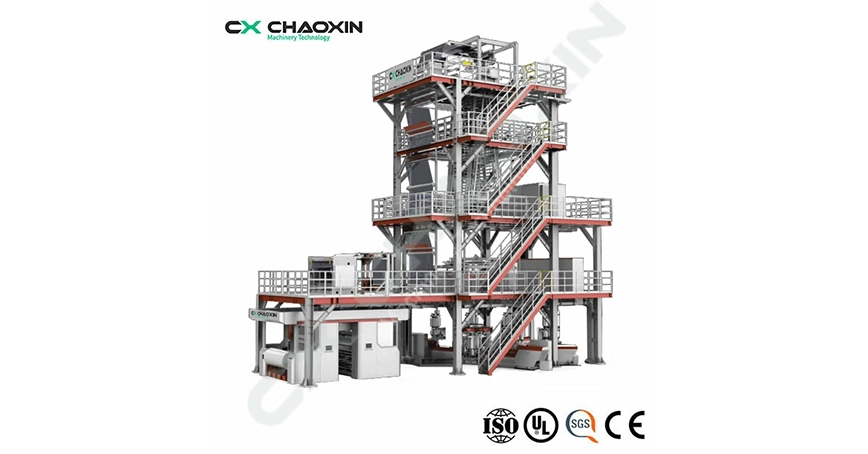
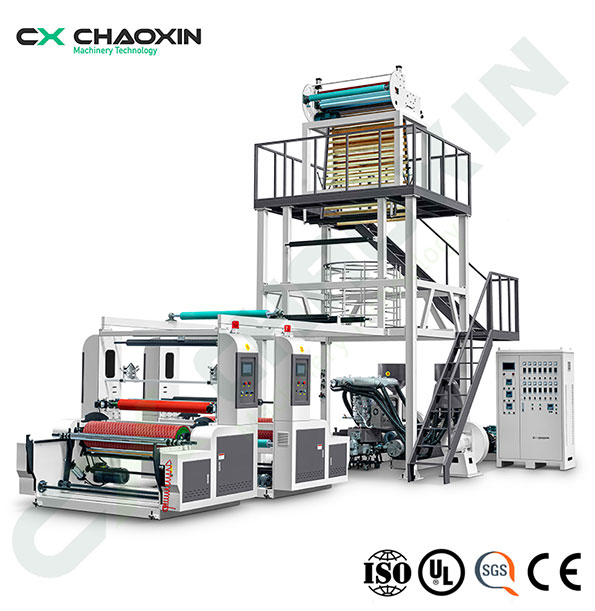
Chaoxin‘s ABA double row high-speed film extrusion machine line is engineered for the flexibility that small-batch, multi-specification production demands. The twin-head configuration uses two sets of extrusion systems, two sets of die heads, and one set of racks. Output ranges from 170 kg/h to 320 kg/h, with LDPE production reaching up to 320 kg/h and HDPE up to 240 kg/h.
The machine features a 32:1 L/D screw, double vent air ring, and inverters from Schneider or ABB for energy-efficient operation. The barrel and screw are made of high-quality alloy steel through nitriding and precision machining. Chaoxin offers a 3-year warranty on parts and provides comprehensive service including installation guidance.
For film manufacturers running diverse product lines — shopping bags, garbage bags, shrink film, agricultural film — the single screw double die head configuration offers production flexibility without the capital cost of two separate extruders. Before you commit, evaluate your width requirements and typical order mix. The right die combination ensures efficient production and consistent quality across both lines.
Ready to run two film widths on one machine? Contact Chaoxin for a quote or product consultation on the ABA double row high-speed film extrusion machine line. Share your target width combinations, materials, and output requirements — their team can recommend the right die configuration for your specific application.
ZHEJIANG CHAOXIN MACHINERY TECHNOLOGY CO., LTD.
Booth No:B104
Time: September 22 – 24, 2026
Add: 107, Amir Timur Street, 100047, Tashkent, Uzbekistan
Exhibition Hall:Central Pavilion, UzExpoCentre, Hall 1
Email: cx1@chaoxin.cn
WEB: www.zjchaoxin.com





 English
 Pусский
 Español