Buying Your First Machine?
Call +86-13958915221
ou're evaluating equipment for food packaging film production. The AB two-layer blown film line keeps coming up in conversations with suppliers. But beyond the basic specs, what should you actually be asking?
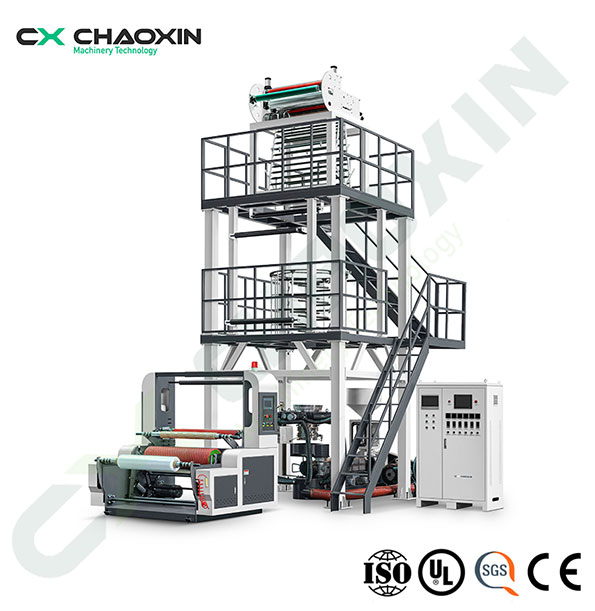
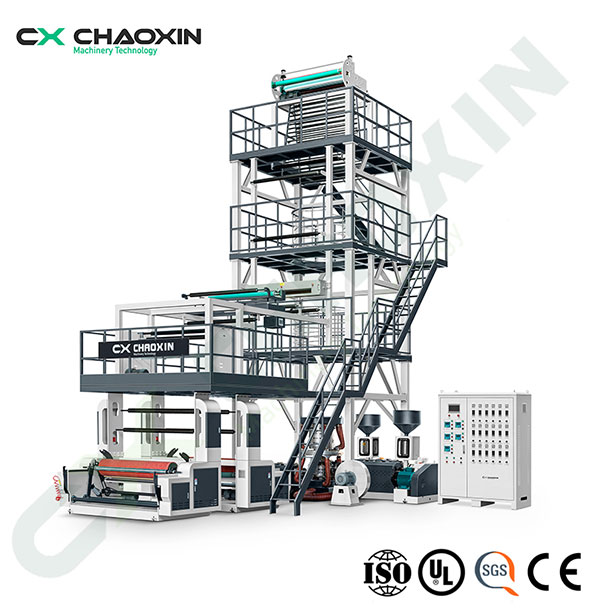
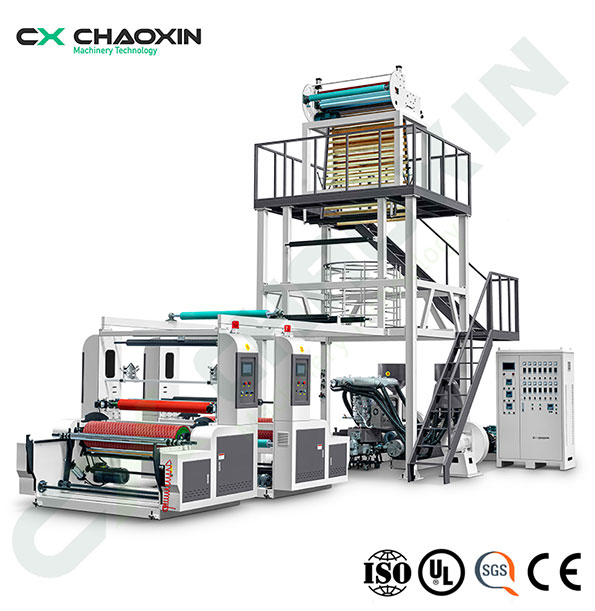
An AB 2Layer Film Blowing Machine is the simplest co-extrusion configuration—two extruders feeding a single die to produce a two-layer film. It's widely used for dry food packaging, frozen food inner liners, and general-purpose barrier films. The structure is straightforward: the A layer (outer) provides mechanical strength and printability; the B layer (inner) handles sealing and direct food contact.
But here's the thing: the machine's capabilities vary significantly between suppliers. Output consistency, layer ratio flexibility, sealing performance, and material compatibility all depend on the machine's design and configuration. A machine that works well for one food type may struggle with another.
This guide is written for buyers—the people who need to evaluate technical proposals, compare supplier offerings, and make a decision that balances performance, cost, and reliability. We'll look at typical layer structures for different food types, key specifications to request, layer ratio considerations, sealing performance expectations, and the questions you should ask before ordering.
The AB structure assigns specific functions to each layer. Knowing what goes where helps you evaluate whether a machine can handle your application.
The outer layer provides mechanical strength and serves as the printing surface. Common materials include LDPE (low-density polyethylene) and LLDPE (linear low-density polyethylene). These materials offer good tensile strength, puncture resistance, and a surface suitable for high-quality printing. For food packaging, the A layer needs to withstand handling, stacking, and transportation without tearing.
The inner layer is where the sealing happens. This layer contacts the food directly, so material selection matters. Recommended materials include metallocene LLDPE or specialized sealing resins that provide strong, consistent heat seals. The B layer's sealing performance determines whether your packages stay closed during storage and transport.
The machine should support the materials you plan to use. For most AB food packaging applications, the combination of LDPE/LLDPE in the A layer and a sealant resin in the B layer covers the majority of dry food and frozen food needs. The key is whether the machine's screw design and temperature control can handle the specific materials you specify.
Not all specifications are equally important. Here are the ones that should be on your checklist.
The screw's length-to-diameter ratio directly affects melt quality and output consistency. For food packaging films, a ratio of at least 30:1 is recommended. This provides adequate residence time for proper melting and mixing. Shorter screws may struggle with certain materials or produce inconsistent melt quality.
The die diameter determines the maximum film width. Machines like the CX-700-1100 series offer film widths from 100-600mm, while larger models like the CX-1300-2200 can handle widths up to 1200-2100mm. Your width requirements depend on your packaging formats and converting equipment.
| Model Series | Film Width Range | Film Thickness | Main Motor |
|---|---|---|---|
| CX-700-1100 | 100-600mm / 400-800mm / 500-1000mm | 0.006-0.10mm | 15KW2 / 18.5KW2 |
| CX-1300-2200 | 800-1200mm / 1000-1600mm / 1200-2100mm | 0.006-0.03mm | 45-65kw avg power |
This is a must-ask question. Does the machine include online thickness measurement capability? Without it, you're relying on manual sampling and lab testing, which means you could produce significant quantities of out-of-spec film before you detect the issue. Machines with integrated gauging systems provide real-time feedback and reduce waste.
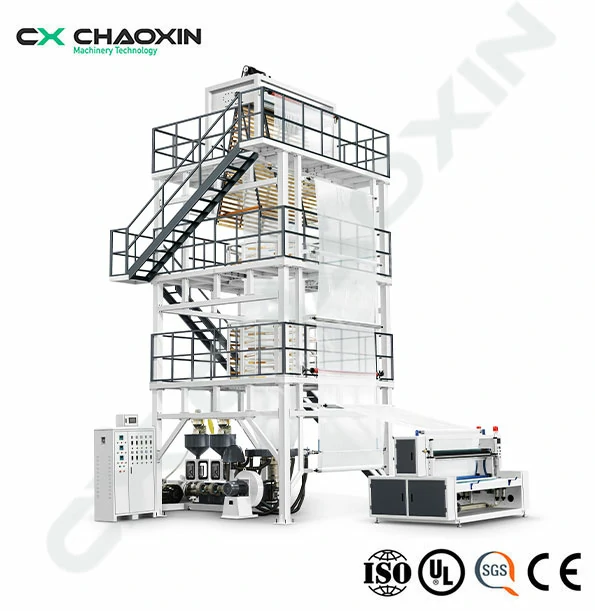
The A:B layer ratio typically ranges from 20:80 to 50:50. But how easy is it to change?
The ratio determines how much material goes into each layer. For some applications, you want a thicker A layer for strength and printability. For others, a thicker B layer provides better sealing or barrier properties. The ability to adjust the ratio without changing hardware is a significant advantage.
The critical question is: can this ratio be changed directly on the control panel? Some machines require screw changes or hardware modifications to adjust the layer ratio. Others allow ratio adjustments through the control system. The latter is far more practical for operations that run multiple products with different layer requirements.
If you're producing biscuit packaging, you might run a 40:60 ratio. For frozen food, you might need a 30:70 ratio for better sealing. Being able to adjust ratios quickly means less downtime between product changes and less material waste during changeovers.
Sealing performance is the most important functional attribute of food packaging film. Here's what you need to know.
Don't accept guaranteed values—ask for actual test data. Request the supplier's seal strength data for the specific structure you plan to run. If they can't provide it, consider that a red flag. Reputable suppliers will have tested their equipment with common food packaging materials.
The most common issue with AB machines is thickness variation across the web. If the film isn't consistently thick, the heat seal will be uneven—wrinkles, weak spots, and seal failures. This is why online thickness measurement and precise temperature control are so important.
The machine's temperature control system plays a major role in sealing quality. Consistent barrel temperatures ensure consistent melt, which means consistent film thickness and reliable seals. The machine's die design and air ring also affect film uniformity.
Beyond the basic specs, certain features deliver real operational benefits.
The machine is designed with energy efficiency in mind. Compared to competitor equipment, it consumes 10-30% less energy while delivering 20-50% higher output. These numbers add up over a year of production—lower utility bills and higher throughput.
Key components include Siemens motors, inverters from ABB or Schneider, slotted screws with speed reducers for operational stability, and cast aluminum screw heating for consistent temperature control. The draw rolls use a five-roll setup, and customized core roll material reduces wrinkles. The Omron temperature control system provides precise temperature control throughout the process.
Each accessory is selected for perfect matching and compatibility. The customized die head produces more accurate film dimensions. This attention to detail in the accessory chain contributes to the machine's overall stability and film quality.
The machine comes with a three-year warranty on major parts. When you purchase, you also receive corresponding raw material formula data. This information helps you achieve optimal results and enhances film quality from the start—reducing the trial-and-error period that often accompanies new equipment.
Does your AB machine support quick change of A layer material?
Yes, the machine's screw design and temperature control system allow for material changes without extensive downtime. The slotted screw design and cast aluminum heating system support quick transitions between different LDPE and LLDPE grades.
What is the typical thickness tolerance across the web?
With the machine's Omron temperature control system and customized die head, typical thickness tolerance is within a tight range. For specific numbers, consult the machine's technical specification sheet for your target film width and thickness.
Can I add a third extruder later to upgrade to ABC?
While the base machine is configured for two layers, the control system and infrastructure can often support future upgrades. Discuss your potential expansion plans with the supplier to understand what options are available for your specific machine configuration.
What documentation is provided for FDA-compliant films?
The supplier provides material data and compliance documentation for films produced on the machine. This includes information about the materials used in the extruder components that contact the film and the temperature control parameters that ensure food-grade processing conditions. For specific FDA compliance inquiries, request the documentation package for your target material structure.
The AB two-layer film blowing machine is a proven solution for a wide range of food packaging applications. The key is matching the machine's capabilities to your specific needs.
Before you specify the machine, know what you'll be producing most frequently. Biscuit packaging, for example, typically uses an LDPE/LLDPE A layer with an EVA sealant B layer. Frozen food packaging often requires different material combinations. The machine's screw configuration and temperature control should be optimized for your primary material set.
The base specifications—film width, thickness range, output rate—are just the starting point. Layer ratio flexibility, online thickness measurement, sealant material compatibility, and the supplier's experience with your specific application are equally important.
Reputable suppliers like CHAOXIN Machinery manufacture blown film machines designed for extrusion use, with a focus on stability and output efficiency. Their AB two-layer line is part of a broader product range that includes biodegradable film machines, three-layer co-extrusion lines, and ABA configurations. The three-year warranty on major parts and the inclusion of raw material recipe data are indicators of a supplier that stands behind its equipment.
If you're in the market for an AB two-layer blown film machine, start by defining your primary film structure. Then work backward—what screw diameter, die width, and layer ratio flexibility do you need? Ask the supplier for test data on your specific structure. And don't forget to factor in energy consumption, output capacity, and after-sales support. The right machine for your operation is the one that matches your application, your material requirements, and your production targets.
Ready to explore your AB film blowing options? Reach out to CHAOXIN Machinery's team with your film specifications and production targets—they can help you determine which configuration matches your needs.
ZHEJIANG CHAOXIN MACHINERY TECHNOLOGY CO., LTD.
Booth No:12859
Time: September 28 – October 2, 2026
Add: Carrera 37 No 24. 67 Bogotá Colombia
Exhibition Hall:Centro Internacional de Negocios y Exposiciones de Bogotá (Corferias)
WEB: www.zjchaoxin.com





 English
 Pусский
 Español