Buying Your First Machine?
Call +86-13958915221
You're running a high-value order for barrier film. The specs are tight, the customer is demanding, and the margin depends on yield. Then you see it—a black speck in the middle of the roll. Or a gel that shows up as a tiny bump in an otherwise perfect surface.
In single-layer film, these defects might be acceptable. In three-layer co-extruded film for food packaging, medical applications, or high-end industrial use, they're rejects. The difference between a good run and a bad one often comes down to understanding where gels and black specks come from in each layer of your ABC 3 layer Blown Film Machine—and having a prevention plan that addresses each source.
This guide walks you through the origins of these defects, material-related prevention strategies, equipment maintenance schedules, purging practices that work, and a daily inspection checklist for operators. For quality managers and process engineers, this is practical guidance for keeping your line clean and your film defect-free.
Not all defects are created equal. Their origin depends on which layer they appear in.
The outer layer is the most common source of black specks. Residue accumulates on the die lip over time—carbonized polymer that breaks off and embeds in the film. The high temperatures at the die exit accelerate degradation, especially if the line stops and restarts. CHAOXIN's machines use high-precision molds and high-efficiency air ring cooling systems to ensure good thickness uniformity, but even the best die needs regular cleaning.
The core layer is where recycled or reclaim material is often used. Reclaim material contains degraded polymer, contaminants, and residues from previous processing. When this material passes through the extruder, it generates black specks that show up in the core layer. CHAOXIN's three-layer co-extrusion blown film production line can use high percentages of recycled material or CaCO3 in the middle layer to effectively reduce costs, but this requires careful quality control of the reclaim stream.
The inner layer often contains additives—slip agents, antiblock, antistat, or processing aids. If these additives aren't properly dispersed, they can form gels that appear as translucent bumps in the film. Inadequate mixing or incorrect screw design for the specific additive package is usually the culprit.
Start with the materials you put into the machine. Poor material quality can't be fixed by better machine settings.
Resins like PA (nylon) and EVOH are hygroscopic—they absorb moisture from the air. When processed with residual moisture, they hydrolyze and degrade, creating gels and black specks. Dry these resins thoroughly before processing. The required drying time and temperature depend on the resin type and moisture content.
Different layers have different contamination risks and quality requirements. A general guideline: use 120 mesh for the inner layer (higher purity requirement), 80 mesh for the outer layer, and 60 mesh for the core layer (where reclaim material is used). These are starting points—actual mesh selection depends on your specific materials and product requirements. CHAOXIN's machines feature optimized screw designs with 30:1 or 32:1 L/D ratios, which improve melt quality and reduce the burden on the screen pack.
For films with strict optical or barrier requirements, limit recycled content to below 20% in the core layer. Higher recycle ratios increase the risk of black specks from degraded material. For non-critical films, you can push the recycle ratio higher to reduce material costs.
Regular maintenance is your best defense against degradation-related defects. A consistent schedule prevents problems before they start.
Carbonized deposits on the die lip are a primary source of black specks. At 500-hour intervals, inspect the die lip carefully. Remove any carbonized material with a brass scraper or specialized cleaning tool. Don't use steel tools—they can scratch the die surface, creating more places for deposits to form.
Every time you change materials, purge the extruder with a low-melt-index resin. This flushes out residual material that could degrade during the next run. Low-MI resin provides effective cleaning without risking degradation at normal processing temperatures.
Screen pack housings accumulate degraded polymer and contaminants over time. Remove and clean the housing monthly, or more frequently if you're running reclaim material. A clean housing ensures consistent melt pressure and reduces the risk of contamination breakthrough.

Purging is only effective if you do it right. Here's what works for three-layer machines.
Mechanical purging uses a low-viscosity resin to physically push out residual material. It's effective for routine material changes but doesn't remove degraded polymer that's stuck to metal surfaces. Chemical purging compounds react with degraded polymer to break it down and remove it. Use mechanical purging for daily changes and chemical purging for deep cleaning after extended runs or severe degradation events.
Don't purge all three extruders at once. Purge each extruder sequentially, starting with the one that's least critical to the run. This prevents cross-contamination between layers. When purging, run the purge material through the die head until the melt stream is clean and free of color or contaminant streaks. CHAOXIN's machines feature PLC logic control with rapid switching speeds and strong anti-interference capabilities, making sequential purging and parameter adjustments more precise.
Operators are your first line of defense against defects. Equip them with a clear checklist.
Check the hopper for foreign material. Contaminants in the hopper—dust, paper, metal fragments—can cause defects. Inspect the hopper at the start of each shift.
Monitor melt pressure for sudden increases. A sudden pressure rise indicates a clogged screen pack or degraded polymer breaking loose. If you see a spike, stop the line and investigate.
Inspect the film surface for repeating spots. A defect that repeats at regular intervals points to a specific roll or die position. Mark the location and check the corresponding die lip area.
Listen for unusual sounds from the extruder or gearbox. Squealing, grinding, or knocking sounds indicate mechanical issues that could lead to degradation.
Record melt temperature readings. A drifting melt temperature can cause degradation or poor mixing. Compare readings against the setpoint and look for trends.
Why do black specks appear only after running for 4 hours?
This is a classic sign of die lip build-up. The die lip accumulates carbonized polymer gradually. It takes a few hours for enough build-up to break loose and appear as black specks in the film. If you're seeing specks only after 4+ hours of running, the die lip needs cleaning. CHAOXIN's high-precision die heads are made from special alloy steel with European five-axis processing equipment, which provides a smoother surface that resists build-up, but regular cleaning is still essential.
Can the die head design cause gels?
Yes. A poorly designed die head creates dead spots—areas where polymer stagnates and degrades. Over time, degraded polymer breaks loose and contaminates the film. A well-designed die head with streamlined flow channels minimizes dead spots. CHAOXIN uses its own flow channel simulation technology and multi-layer co-extrusion process to ensure even film thickness, which reduces the risk of dead spots and degradation.
Does screw design affect gel formation?
Absolutely. The screw's mixing section determines how well additives are dispersed and how thoroughly the polymer is homogenized. A screw that's mismatched to the material can create unmelted polymer (gels) or degrade the material through excessive shear. CHAOXIN's optimized screws with 30:1 or 32:1 L/D ratios improve extrusion volume, lifespan, and anti-corrosion/anti-grind ability—all of which contribute to melt quality. Double alloy screws with vacuum fire treatment provide better performance than single alloy screws.
What is the difference between a hard gel and a soft gel?
A hard gel is typically cross-linked polymer that won't melt at normal processing temperatures. It appears as a solid, often yellowish or brownish particle. A soft gel is unmelted polymer that softens but doesn't fully melt at processing temperature. Hard gels usually come from degraded polymer or contamination; soft gels come from poor mixing or incorrect temperature settings. Soft gels can sometimes be eliminated by adjusting the temperature profile or screw speed; hard gels require cleaning or material changes.
When you're running a three-layer co-extrusion line, the machine's design and construction directly affect your ability to prevent defects.
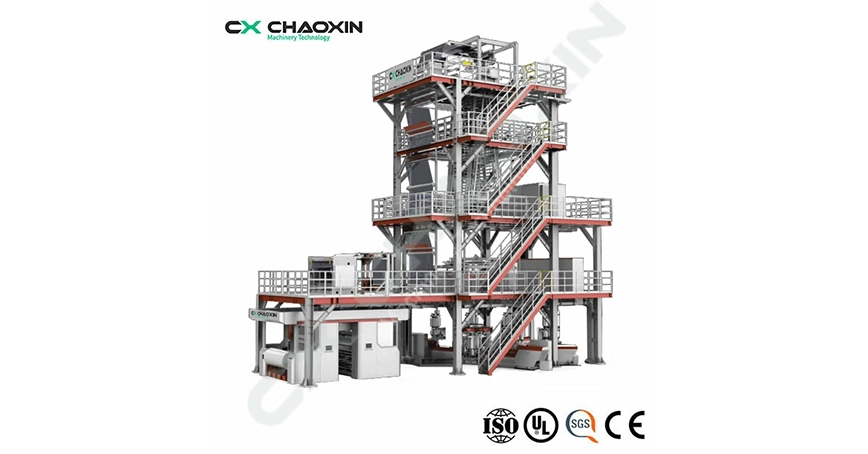
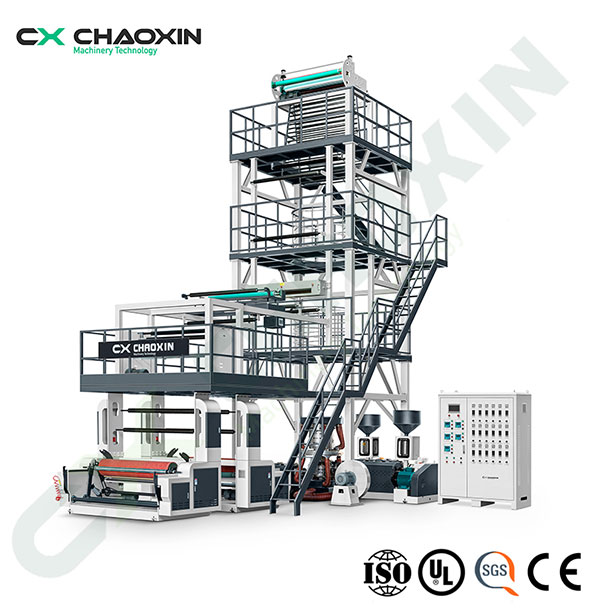
CHAOXIN Machinery manufactures ABC three-layer blown film machines designed for high-quality co-extrusion production. Their machines feature optimized screws with 30:1 or 32:1 L/D ratios, double alloy construction with vacuum fire treatment, and Siemens, Brook, or GE main motors. The inverter systems come from Schneider (France) or ABB (Switzerland), and temperature controllers are from Omron. CHAOXIN offers a 3-year warranty on parts and comprehensive service support.
The machines are available in multiple models—CX-ABC-1300, CX-ABC-1600, and CX-ABC-2200—with film widths from 800mm to 2050mm, film thickness from 0.02-0.20mm, and maximum extrusion output from 180kg/h to 280kg/h. The die diameters range from 250mm to 500mm. CHAOXIN's machines are CE certified and have a number of international certifications to ensure product quality.
The company's high-precision molds and high-efficiency air ring cooling systems ensure good thickness uniformity and high output efficiency. The cold water roller design rapidly reduces temperature, improves cooling efficiency, increases production, enhances film transparency, and reduces adhesion. For quality managers concerned about gels and black specks, these features—precise temperature control, efficient cooling, and high-quality components—make a measurable difference in defect rates.
Preventing gels and black specks in three-layer blown film isn't complicated. It requires understanding where defects come from, implementing material controls, following a maintenance schedule, using effective purging practices, and training operators to spot problems early. With the right machine and the right processes, you can produce clean, defect-free film consistently. CHAOXIN's three-layer co-extrusion machines provide the precision and reliability needed to meet high-quality standards.
Ready to improve quality on your three-layer blown film line? Reach out to CHAOXIN Machinery's technical team—they can provide process optimization guidance, maintenance recommendations, and machine specifications to help you reduce defects and improve yield.
ZHEJIANG CHAOXIN MACHINERY TECHNOLOGY CO., LTD.
Booth No:12859
Time: September 28 – October 2, 2026
Add: Carrera 37 No 24. 67 Bogotá Colombia
Exhibition Hall:Centro Internacional de Negocios y Exposiciones de Bogotá (Corferias)
WEB: www.zjchaoxin.com





 English
 Pусский
 Español