Buying Your First Machine?
Call +86-13958915221
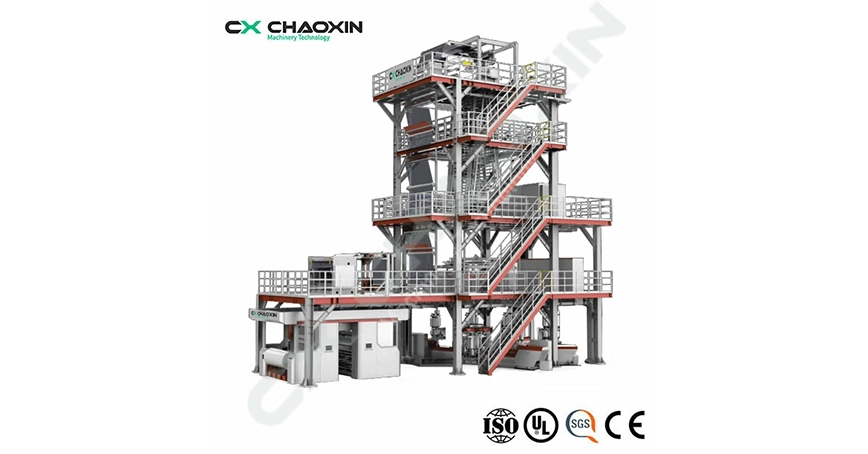
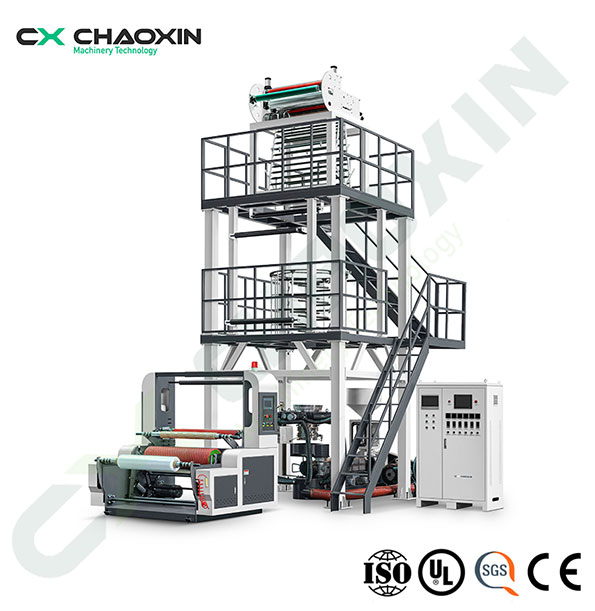
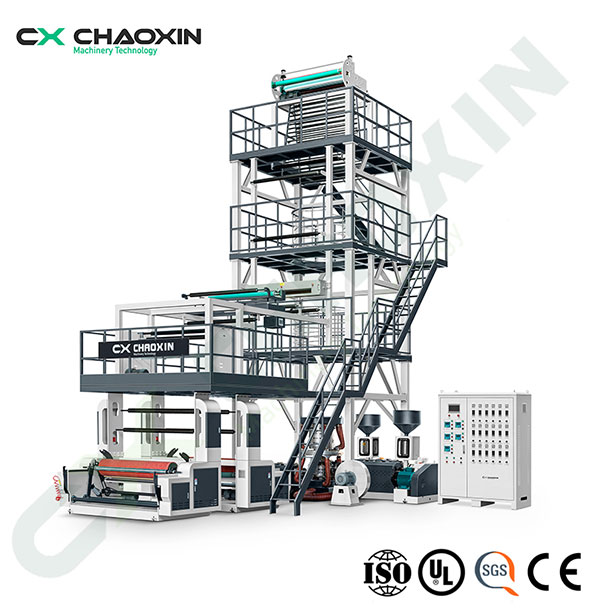
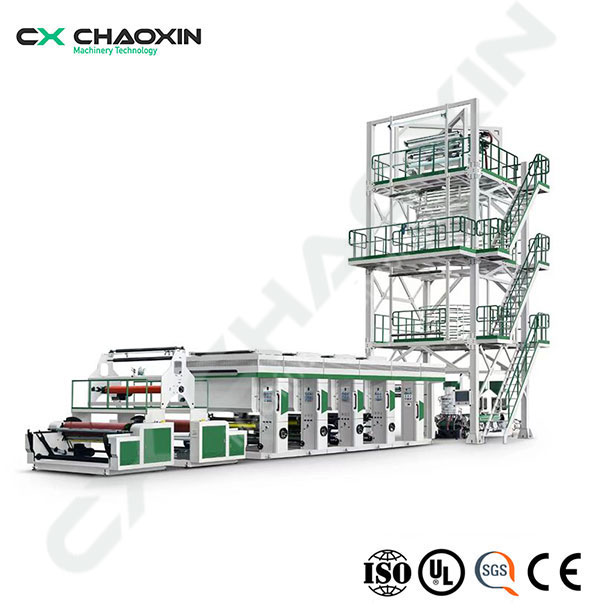
In an ABC 3 Layer Blown Film Machine, the three layers exit separate extruders and merge only in the die. Layer A (outer) controls surface finish and coefficient of friction. Layer B (core) carries the bulk of the thickness and determines bubble stability. Layer C (inner sealant) often uses a lower melt index resin and requires less aggressive heating to avoid degradation.
The outer layer determines gloss, haze, coefficient of friction, and printability. Running the A extruder at a slightly higher temperature (around 210–215°C at the metering zone) reduces melt fracture and yields a smoother surface. However, excessive temperature in the outer layer can increase COF and make the film feel sticky or tacky, which causes problems on high-speed form-fill-seal lines. If the outer layer also contains slip or antiblock additives, running too hot can drive those additives to the surface prematurely, creating a greasy film that is difficult to handle.
The core layer is typically the thickest portion of the film (often 50–70% of total thickness). It requires sufficient melt fluidity to fill the die channels evenly, but if the temperature is too high, the melt strength drops and the bubble becomes unstable, leading to oscillations and thickness gauge bands. In ABC co-extrusion, the core layer temperature is typically kept moderate (190–210°C at metering). The core also determines how the bubble responds to cooling air; a core that is too hot will have a longer freeze line and may sag.
The inner sealant layer often uses a different LLDPE grade with a lower melt index (MI). Lower MI resins require higher temperatures to flow, but excessive heat can degrade the resin, cross-link it, or drive off slip additives, ruining heat seal properties. In many ABC structures, the inner layer runs 5–10°C cooler than the outer layer to preserve seal initiation temperature and avoid burnt taste or odor in food contact applications.
| Zone | Recommended Temperature Range (°C) | Notes |
|---|---|---|
| Feed zone (hopper to first barrel section) | 170–180 | Prevent bridging and melt fracture; avoid overfeeding |
| Compression zone (middle barrel sections) | 190–210 | Primary plasticization area; adjust for output rate |
| Metering zone (final barrel sections) | 200–215 | Homogenization; set 5°C lower for inner sealant layer |
| Adapters (connecting extruder to die) | 210–220 | Must match die temperature; avoid temperature drop |
| Die body (all layers merge) | 210–220 | Maintain temperature uniformity around circumference |
The total number of temperature control zones varies by machine model. Chaoxin‘s ABC lines typically feature 15–20 PID-controlled zones, allowing independent barrel heating control per extruder plus separate die zone control. This level of precision is essential when processing LLDPE blends or when running different melt flow resins in different layers.
Masterbatch carriers often have lower melt points than the base LLDPE. Excess heat can degrade the pigment or carrier, causing black specks or color shift. Reduce barrel temperatures by 5–8°C across all zones when masterbatch loading exceeds 5%. For white or heavily pigmented films, consider a masterbatch formulated specifically for blown film with a carrier matched to LLDPE.
Recycled material typically contains degraded polymer chains, cross-linked gels, or contaminants that increase melt viscosity and pressure. Processors report that raising barrel temperatures by 3–5°C helps overcome the higher viscosity and improves dispersion. However, running recycled LLDPE too hot accelerates further degradation, generating smoke, odors, and die buildup. The best practice is to increase compression zone temperatures moderately (3–5°C) while keeping die temperature unchanged. For higher recycled loads (30–50%), consider a dedicated screw design with a deeper channel and mixing section to handle the contaminants without excessive heating.
Gels or fisheyes on the surface. Small unmelted polymer particles appear as transparent specks or bumps. This indicates the compression or metering zone temperature is too low, especially in the extruder feeding the outer layer. Increase the metering zone temperature in 5°C increments until gels disappear.
Yellowing, browning, or smoke. Thermal degradation has occurred. LLDPE begins to discolor above 240°C. Immediately reduce temperatures by 5–10°C. If yellowing persists, check for thermocouple calibration drift—actual temperature may be 20–30°C above setpoint.
Layers peel apart by hand. Poor interlayer adhesion means the melt temperatures of adjacent layers do not match closely enough. For LLDPE-on-LLDPE structures, all three extruder metering zones should be within 10–15°C of each other. If the temperature difference exceeds 20°C, delamination is likely. Adjust the colder layer upward or the hotter layer downward.
Bubble oscillates or uneven frost line. The core layer melt temperature is too high, reducing melt strength. Lower the B extruder metering zone temperature by 5°C. Also verify cooling air flow is balanced.
A mid-sized packaging converter in Ohio switched from LDPE to LLDPE for their high-clarity food bags. The existing ABC line had been running LDPE at 180–190°C across all zones. After the switch to LLDPE, the machine experienced high melt pressure, extruder amps spiked, and the film showed visible gels and poor clarity. The initial response was to increase temperatures across the board, which reduced pressure but introduced yellow discoloration and layer delamination.
The process engineer ran a systematic adjustment sequence. First, the A (outer) and C (inner) extruders were set to 200°C metering; the B (core) extruder was set to 195°C. Adapter and die temperatures were raised to 215°C. These values came from the recommended table. After stabilizing for one hour, film clarity improved but small gels persisted. The metering zone on the A extruder was increased to 210°C, and the B extruder was dropped to 190°C—a 20°C spread that balanced flow and melt strength. The engineer also verified that the thermocouple in the A extruder adapter was reading accurately; it was off by 15°C due to a loose connection, and after correction the true adapter temperature dropped from 230°C to 215°C, eliminating the yellowing. The final film met all specifications, and the same profile became the plant standard for all LLDPE food bag orders.
Q: Should all three extruders have identical barrel temperatures when processing the same LLDPE grade?
A: Not necessarily. While the same base resin reduces some variability, the outer layer benefits from slightly higher temperature (better surface finish), the core benefits from slightly lower temperature (higher melt strength, better bubble stability), and the inner sealant layer may need the lowest temperature to preserve seal initiation properties. A common starting profile is outer extruder 210°C metering, core 195°C, inner 200°C.
Q: How to set temperature if running EVOH as a barrier layer in the B position?
A: EVOH requires a narrow temperature window (typically 170–210°C depending on ethylene content). LLDPE does not bond directly to EVOH; a tie layer (maleic anhydride-grafted PE) is required between B and the adjacent layers. The tie layer temperature usually matches the warmer of the two adjacent layers. In such cases, the B extruder runs EVOH with its own profile; tie layer extruders run between 190–210°C. The die temperature must be set to the highest common temperature that avoids degrading the most heat-sensitive material (usually EVOH).
Q: What data logger is commonly used for profile monitoring?
A: Most modern ABC lines integrate temperature monitoring into the PLC (e.g., Siemens S7-1200). For validation, a handheld infrared or contact pyrometer can spot-check die surface temperatures. Some processors use data logging software (Wonderware, Ignition, or machine HMI) that records all zone temperatures every 30 seconds. Reviewing historical trends helps detect thermocouple drift or failing heater bands before they cause quality issues.
Temperature optimization on an ABC 3 Layer Blown Film Machine is not a “set once” task. Processors should record barrel, adapter, and die temperatures weekly and compare them against baseline values for each film structure. The key measurements to document include feed, compression, and metering zone temperatures for all three extruders, adapter temperatures, die body temperatures, actual melt temperature at the die exit (measured with a pyrometer), and chill roll temperature. By building a history of successful settings versus product defects, the process engineer can establish a correlation that reduces troubleshooting time from hours to minutes. Chaoxin‘s ABC lines are designed with independent temperature control per layer, allowing precise adjustment to match the unique requirements of LLDPE—whether running virgin, recycled, or masterbatched compounds.
→ Request a quote from Chaoxin Machinery for the Three-Layer Co-Extrusion High-Pressure Film Blowing Unit Configuration — Share your typical LLDPE melt index, target film thickness, layer ratio preferences (e.g., 15%/50%/35%), and whether you need to process recycled content or masterbatch. Their technical team can recommend the right extruder sizing and temperature zone configuration for your specific production needs.
ZHEJIANG CHAOXIN MACHINERY TECHNOLOGY CO., LTD.
Booth No:18.1F20
Time:October 15 – 19, 2026
Add:Canton Fair Complex (Pazhou), Guangzhou
WEB: www.zjchaoxin.com





 English
 Pусский
 Español