Buying Your First Machine?
Call +86-13958915221
Every Blown Film Machine follows the same four steps, but the quality of each step determines the final product. A poorly designed machine will produce film with uneven thickness, weak seals, or visible defects.
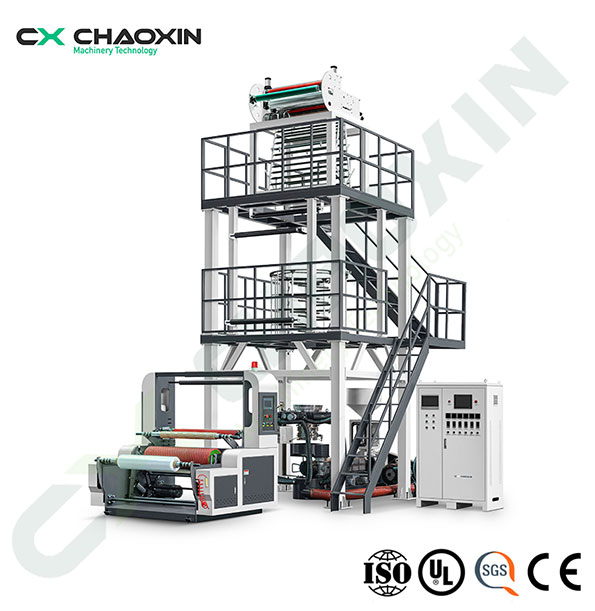
Plastic pellets are fed into an extruder. A rotating screw pushes the material forward while heaters melt it. Better lines use double alloy screws with length‑to‑diameter ratios of 30:1 or 32:1. Why does that matter? Longer screws mean more thorough mixing, fewer unmelted particles, and a more uniform melt. Cheap screws leave “crystal points” – hard, unmelted specks that ruin optical clarity and create weak spots in the film.
Melted plastic exits through a circular die. Air blown into the center expands the plastic into a bubble. Air rings cool the bubble from the outside. The cooling rate and air pressure directly affect film thickness, clarity, and mechanical strength. Inconsistent cooling creates weak spots that can tear during bag making. Some advanced lines use dual air rings or IBC (internal bubble cooling) systems to improve uniformity.
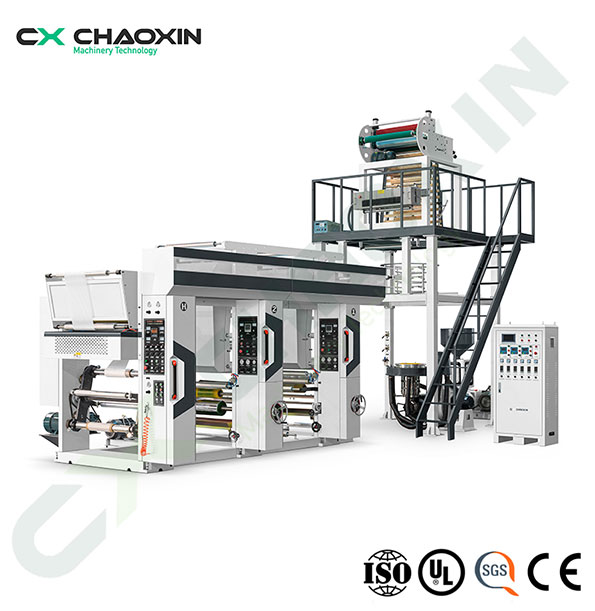
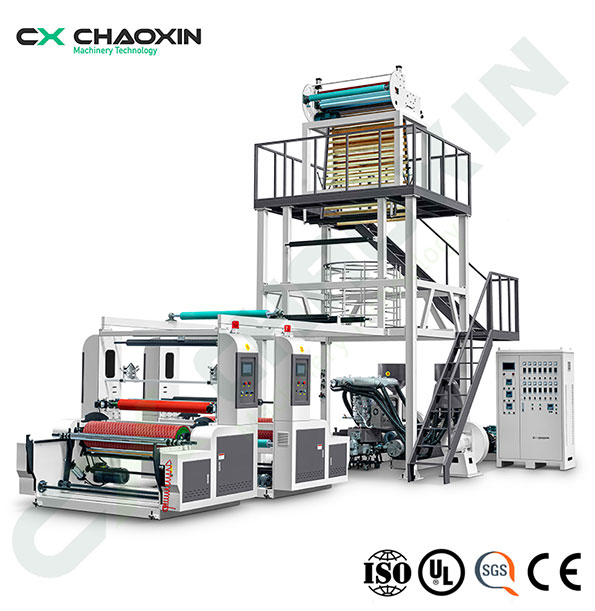
The bubble collapses between nip rollers into a flat tube, then winds into rolls. Modern lines use five‑roller traction systems to keep the film flat and tension consistent. Fewer rollers often lead to wrinkles or uneven winding. If the winding tension is wrong, the roll will telescope – layers slide sideways, making it unusable on high‑speed bag machines.
Old mono‑layer lines produce one material at a time. That’s fine for simple bags, but useless for high‑barrier food packaging or multilayer agricultural films that need different properties on each side.
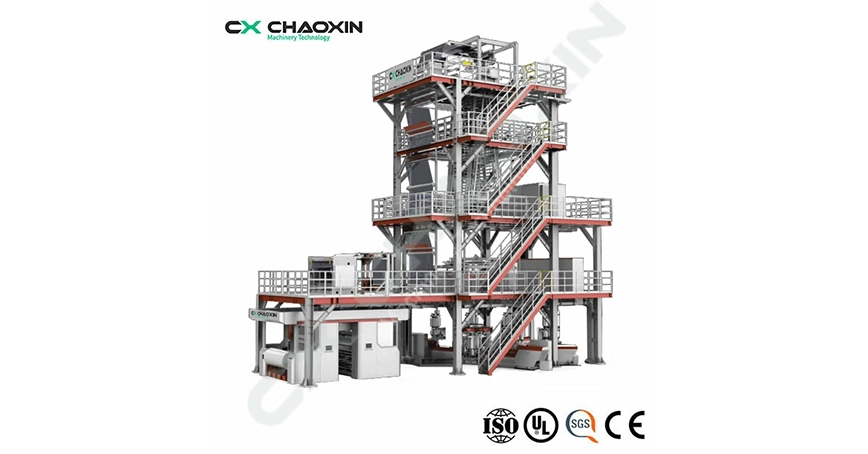
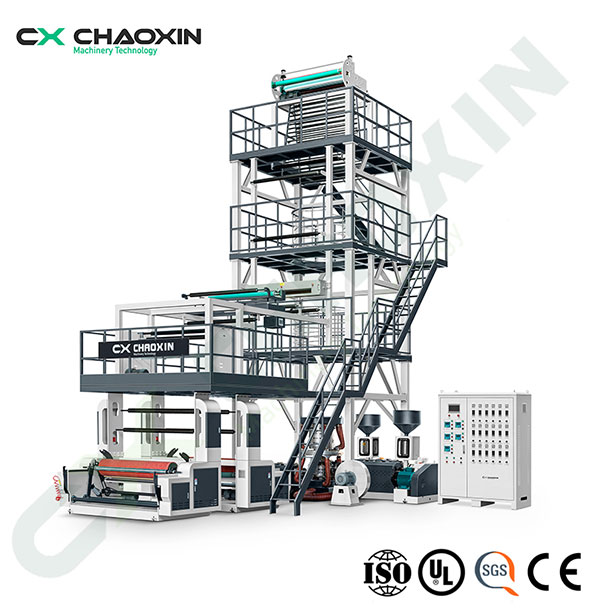
Co‑extrusion lines use two or three extruders feeding the same die. Each extruder handles a different material – for example, a cheap inner layer for strength and a premium outer layer for sealability or appearance. A three‑layer structure can have a white outer layer, a black middle layer (for UV protection), and a sealable inner layer – all in one pass.
ABA means two outer layers of one material and a middle layer of another. It’s a popular configuration because it improves performance without using expensive material everywhere. For example, you can put a high‑grade anti‑block additive only in the thin outer layers while the thick middle layer uses standard material. Chaoxin builds three‑layer co‑extrusion and ABA blown film machines.
The table below shows five critical components and what to look for. These parts directly affect your reject rate, energy bill, and uptime.
| Component | What to look for | Why it matters |
|---|---|---|
| Screw | 30:1 or 32:1 double alloy | Better mixing, less waste |
| Motor | Siemens, GE, Brook | Stable speed, no drift |
| Inverter | ABB or Schneider | Precise motor control |
| Temperature control | Omron + cast aluminum heaters | Even heat, fewer wrinkles |
| Traction | Five‑roller | Flat film, consistent tension |
| Winding | Patented multi‑mode | Tight, telescope‑free rolls |
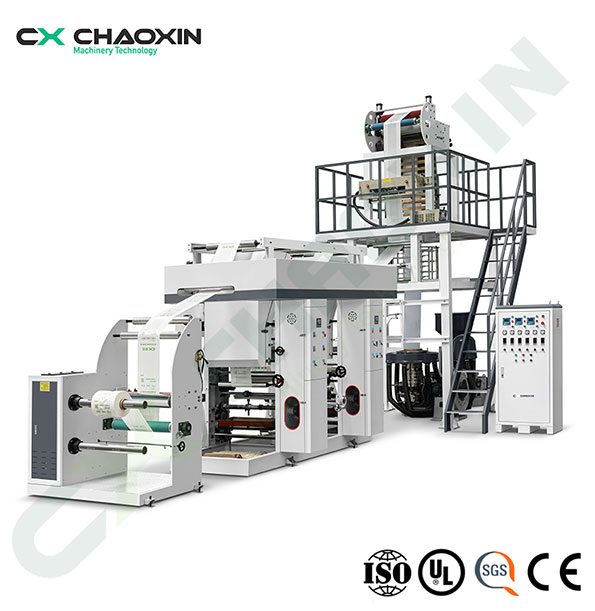
Chaoxin uses self‑developed double alloy screws, international brand motors, five‑roller traction, and multiple winding patents. Each of these choices reduces downtime and material waste.
Buyers focus on speed and output, but energy consumption and warranty tell you a lot about a manufacturer’s confidence.
Film extrusion is energy‑intensive – a line running 24/7 can consume as much electricity as a small factory. A 10% difference in energy efficiency can add tens of thousands of dollars per year to your operating costs. Chaoxin uses precise control systems and optimized processes to reduce energy use and waste. Over a year, those savings add up to real profit.
Most blown film manufacturers offer a one‑year warranty on core components. Chaoxin offers three years. That’s not a marketing gimmick – it means they trust their engineering. If a screw, barrel, or gearbox fails in year two, you’re covered. For a production line running 24/7, that peace of mind is worth a lot.
Biodegradable and compostable resins behave differently from standard polyethylene. They are more sensitive to temperature and shear, and they have lower melt strength. Running them on a machine designed only for PE often leads to bubble instability and frequent breaks.
Chaoxin designs lines specifically for biodegradable films – screws and dies tuned for the material, plus cooling systems that handle lower melt strength without collapsing the bubble. The screw geometry is different, with tighter compression ratios and smoother transitions.
If you supply packaging to markets in Europe or North America, demand for compostable films is rising fast. A machine that can handle both standard and biodegradable resins gives you flexibility. You can run PE today, switch to PBAT or PLA tomorrow, and capture premium pricing.
A modern Blown Film Machine is more precise, more flexible, and cheaper to run per ton than an old mono‑layer unit. The best ones combine:
High‑efficiency 30:1 or 32:1 double alloy screws – for consistent melt quality
Reliable drives from Siemens, ABB, or Brook – no speed drift over time
Omron temperature control plus cast aluminum heaters – even heat across the barrel
Five‑roller traction – flat film with no wrinkles
Three‑year warranty on core components – a real sign of confidence
Energy‑saving controls – reduces electricity bills
Biodegradable resin compatibility – future‑proof your production
Chaoxin builds all of these into their machines. In 2023, they set up a dedicated import/export subsidiary to serve overseas buyers, making ordering, shipping, and support easier for international customers.
You don’t have to be ready to order. Chaoxin can arrange a factory visit or send production videos showing their machines running your target materials – standard polyethylene, biodegradable resins, or both. Ask for a run test with your own material if you want to see real numbers.
[Get the actual energy consumption report]
ZHEJIANG CHAOXIN MACHINERY TECHNOLOGY CO., LTD.
Booth No:R26
Time: October 8–10, 2026
Add: Seashell Lane, Mall of Asia Complex, Pasay City, Philippines
Exhibition Hall:SMX CONVENTION CENTER MANILA
WEB: www.zjchaoxin.com





 English
 Pусский
 Español