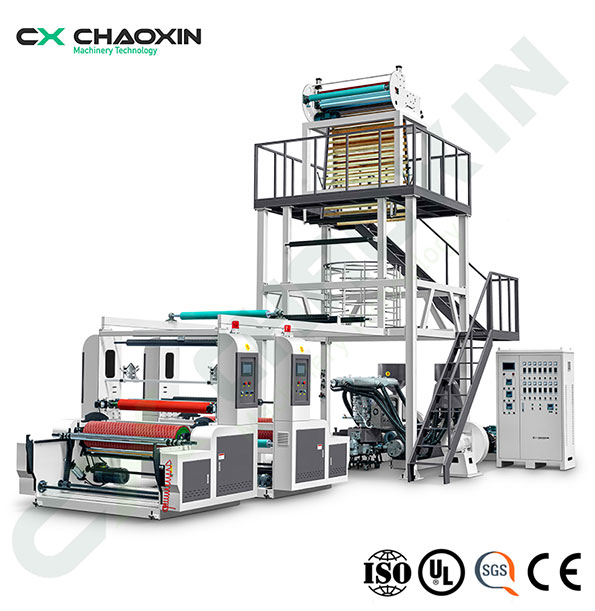
Buying Your First Machine?
Call +86-13958915221
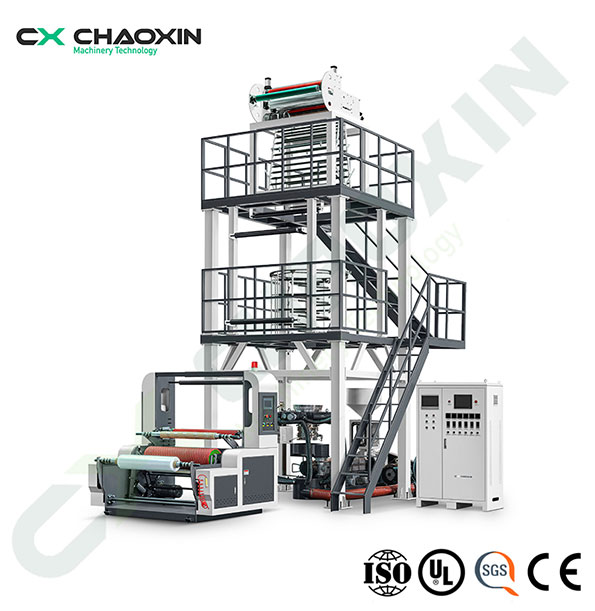
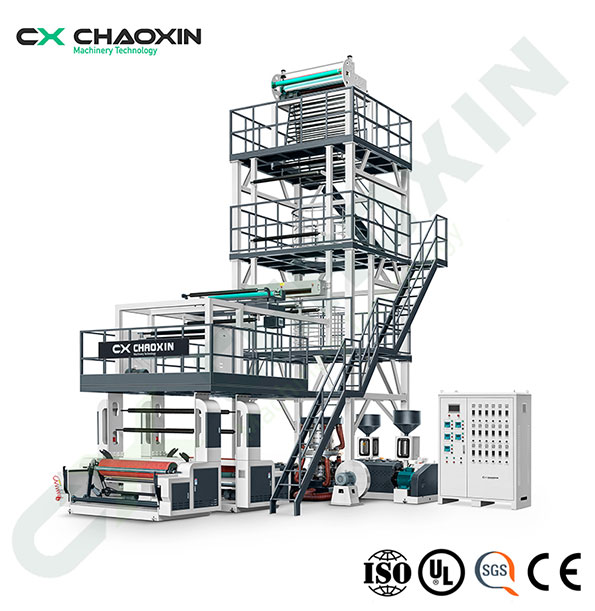
Because it turns reactive quality checks into proactive adjustments. A Mono Layer Blown Film Machine equipped with an EMS (Extrusion Monitoring System) tracks melt pressure and screw speed in real time, so the operator sees a drift before the film gauge drifts out of tolerance. The CX series from Chaoxin pairs this monitoring system with a 65–80mm screw, a 32:1 L/D ratio, and outputs up to 200 kg/h on LDPE. This article explains how the EMS loop works, what the screw geometry contributes to melt consistency, and what to verify when you're matching a monitored single-layer line to your film product mix.
The EMS system monitors and adjusts the extrusion process in real time to ensure film stability. That means it's watching the variables that determine film gauge: melt pressure at the die, screw speed, and the corresponding output rate. When the pressure drifts—because of a temperature change, a raw material variation, or a partially clogged screen—the EMS signals the condition before the film thickness moves.
The operator doesn't have to wait for a gauge measurement at the winder to discover a problem. The EMS provides the feedback loop that turns a reactive quality check into a proactive adjustment.
The monitoring function is paired with an independent PLC control system and a human-machine interface. The PLC handles the digital regulation of extrusion temperature, screw speed, traction speed, and winding tension. The HMI gives the operator a screen-based view of those parameters and a memory function for storing settings.
That combination is what makes the EMS useful on a production floor. The data isn't just logged—it's presented in a way that the operator can act on, and the settings can be recalled when the next job runs.
The CX series covers three screw diameters across its models: 65mm, 70mm, and 80mm. The screw L/D ratio is 32:1 or 30:1, which gives the screw enough length to fully melt and homogenize the polymer before it reaches the die. A longer screw means more residence time, better mixing, and a more uniform melt temperature—all of which reduce the pressure fluctuations that the EMS is watching.
The combination of the longer screw and the EMS feedback is what keeps the film gauge stable. A short screw can produce a melt with temperature and pressure variations that no monitoring system can fully correct.
| Parameter | CX-1300 | CX-1600 | CX-2100 |
|---|---|---|---|
| Suitable materials | HDPE, LDPE, LLDPE | HDPE, LDPE, LLDPE | HDPE, LDPE, LLDPE |
| Film width | 800–1200mm | 1000–1500mm | 1200–2000mm |
| Film thickness | 0.006–0.10mm | 0.006–0.10mm | 0.006–0.10mm |
| Max. output (HDPE) | 100 kg/h | 120 kg/h | 150 kg/h |
| Max. output (LDPE) | 150 kg/h | 180 kg/h | 200 kg/h |
| Screw diameter | 65mm | 70mm | 80mm |
| Screw L/D | 32:1 / 30:1 | 32:1 / 30:1 | 32:1 / 30:1 |
| Main motor | 30 kW | 37 kW | 45 kW |
| Die diameter (HDPE) | 120mm | 300mm | 500mm |
| Die diameter (LDPE) | 250mm | 350mm | 500mm |
| Traction roller width | 1300mm | 1600mm | 2100mm |
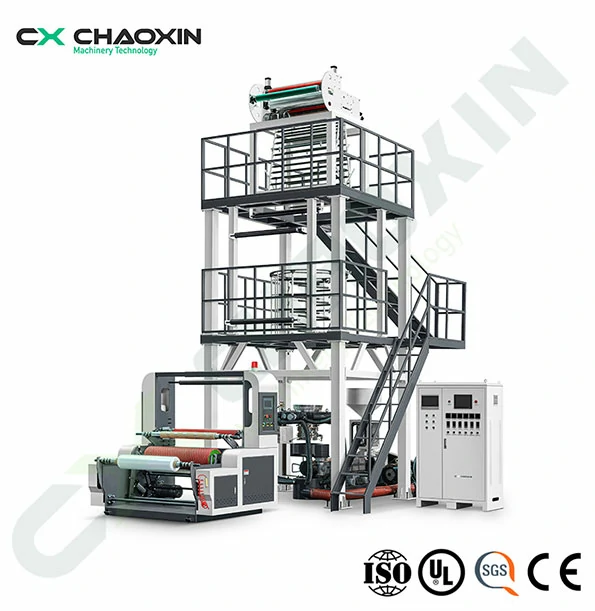
The CX-1300 delivers 150 kg/h on LDPE and 100 kg/h on HDPE. The CX-1600 moves up to 180 kg/h LDPE / 120 kg/h HDPE, and the CX-2100 reaches 200 kg/h LDPE / 150 kg/h HDPE. The output scaling follows the screw diameter: the 65mm screw on the CX-1300 feeds the smaller die, and the 80mm screw on the CX-2100 feeds the 500mm die.
The LDPE output is consistently higher than the HDPE output on the same model because LDPE has a lower melt viscosity and flows more readily through the die. The operator sets the line speed and the die gap according to the material, and the EMS tracks the resulting pressure to confirm the output is stable.
The film width range runs from 800–1200mm on the CX-1300 to 1200–2000mm on the CX-2100. The film thickness range is 0.006–0.10mm across all three models. That thickness window covers the packaging films used in shopping bags, garbage bags, shrink film, and agricultural covers.
The EMS system matters most at the thinner end of that range. A 6-micron film has very little tolerance for pressure variation, and a small drift that would be invisible on a 50-micron film shows up as a gauge failure on a 6-micron film.
The CX series is built for shopping bags, garbage bags, shrink film, agriculture film, express bags, milk bags, industrial packing bags, and biodegradable films. Each of those products has a different balance of strength, clarity, and gauge tolerance, and the EMS-monitored line gives the operator the feedback to hold that balance across a production run.
The supermarket and food products application notes on the product page point to the two largest volume segments: retail carry bags and food-contact packaging. In both cases, a gauge drift that produces a thin spot becomes a quality defect that the customer sees as a weak bag or a seal failure.
The line also supports biodegradable materials. That's a significant capability in a market where packaging regulations are tightening. Biodegradable resins like PLA and PBAT have narrower processing windows than LDPE, and the EMS monitoring helps the operator stay inside that window without trial-and-error.
Check the film width range against your widest product. The CX-1300 covers 800–1200mm, the CX-1600 covers 1000–1500mm, and the CX-2100 covers 1200–2000mm. Then check the output against your required throughput. If your product mix is dominated by LDPE carry bags, the CX-1600 at 180 kg/h may be the balance point between capacity and floor space. If you run wide agricultural film, the CX-2100's 2000mm width and 200 kg/h LDPE output provide the headroom.
The main motor options include Siemens (Germany), Brook (UK), and GE (USA) . The inverter is Schneider (France) or ABB (Switzerland) , and the temperature-controlled meter is Omron. Those component choices matter for uptime and spare-parts availability. A line built with globally recognized brands has a shorter lead time for replacement parts than a line built with proprietary components.
Clean the die and the screen pack according to the pressure reading on the EMS. A rising pressure trend indicates a partially blocked screen, and continuing to run with a blocked screen forces the screw to work harder and raises the melt temperature. Inspect the screw for wear at the feed section and the metering section. Check the EMS sensors for calibration drift—a sensor that reads high or low will mislead the operator's adjustment decisions.
The main motor ranges from 30 kW to 45 kW, and the air blower from 5.5 kW to 11 kW. The average power consumption is 30 kW, 40 kW, and 50 kW across the three models. The machine dimensions run from 6×3.5×6.5m on the CX-1300 to 7×4.5×9.5m on the CX-2100, with weights from 5.5T to 8.5T. Confirm the floor loading and the available length before installation.
A standard pressure gauge shows the operator a reading at a single point in time. The EMS system monitors the pressure continuously and integrates that reading with screw speed and temperature data. It provides a real-time picture of the extrusion process rather than a snapshot, so the operator can see a trend developing and correct it before the film gauge drifts.
Yes. The screw L/D is specified for both HDPE and LDPE, and the die diameter changes between the two materials—120mm vs. 250mm on the CX-1300, for example. The operator switches the die and adjusts the temperature profile when changing materials, and the EMS confirms that the new setup is running at the expected pressure.
Thickness variation comes from three sources: melt pressure fluctuation at the die, temperature variation across the die, and traction speed instability. The EMS addresses the pressure side by giving the operator real-time feedback. The die heating and the traction control address the other two. If the thickness varies despite stable EMS readings, check the die for partial blockage and the traction rollers for wear.
The EMS function is integrated into the PLC and HMI that control the line. There's no separate computer or third-party monitoring package required. The operator interacts with the system through the machine's HMI, and the PLC stores the process parameters for recall on subsequent runs.
A Mono Layer Blown Film Machine with EMS monitoring should match your material mix, film width, and gauge tolerance—not the other way around. The CX series from Chaoxin covers 65–80mm screws, 800–2000mm film widths, and 0.006–0.10mm thickness at outputs up to 200 kg/h LDPE, with real-time extrusion monitoring through the EMS system and PLC/HMI parameter control. The line supports HDPE, LDPE, LLDPE, and biodegradable resins, with Siemens/GE main motors and Schneider/ABB inverters for component reliability. If you're specifying a single-layer line where film gauge consistency is the deciding factor, send us your material, width, and gauge tolerance — we'll help you confirm the right model and monitoring configuration before you order.
ZHEJIANG CHAOXIN MACHINERY TECHNOLOGY CO., LTD.
Booth No:A1-1532
Time:November 17 – 20, 2026
Add:Jl. Gatot Subroto No.1, RT.1/RW.3, Gelora, Kecamatan Tanah Abang, Kota Jakarta Pusat, Daerah Khusus Ibukota Jakarta 10270
WEB: www.zjchaoxin.com





 English
 Pусский
 Español