Buying Your First Machine?
Call +86-13958915221
You're running a line for courier bags or bread bags, and the seal has to hold under load — a mailer that splits at the side seam during transit is a returned parcel and a damaged reputation. A Side Seal Bag Making Machine produces courier mailers, bread bags, and retail packaging by welding the film edges parallel to the direction of film travel, creating a seam that runs along the length of the bag rather than across its width. The CX-SB series from Chaoxin runs this process at 200 pcs/min (or 200×2 pcs/min in the dual-lane configuration) from PE and PBAT film in thicknesses from 0.008mm to 0.05mm. This article explains how the side-sealing process works, what the dual-lane configuration delivers in throughput, and what to verify when you're specifying a line for courier or retail bag production.
The defining feature of a side-seal bag is the seam orientation. In a bottom-seal bag, the film is folded and the seal runs across the width of the bag, closing the bottom. In a side-seal bag, the film is folded along its length and the seals run parallel to the film travel direction, closing the two side edges.
That orientation changes the bag's structure and its failure mode. A side-seal bag has two longitudinal seams and one folded edge. The seams carry the load when the bag is lifted, so the seal quality along the full length of the bag determines whether the bag survives handling. For courier bags, where the contents may be heavy or sharp-edged, that longitudinal seam strength is the critical specification.
The CX-SB series uses hot-bar sealing to form the side seams. A heated bar presses the folded film layers together, melting the polymer at the interface and bonding the layers as the bar retracts. The sealing temperature and pressure are set according to the film type and thickness.
In some configurations, a flying knife with integrated heating seals and cuts the film in one motion. The continuous rotary knife passes along the film edge, simultaneously welding the seam and separating the finished bag. That combined action is what allows the machine to run at production speed without a separate cutting station.
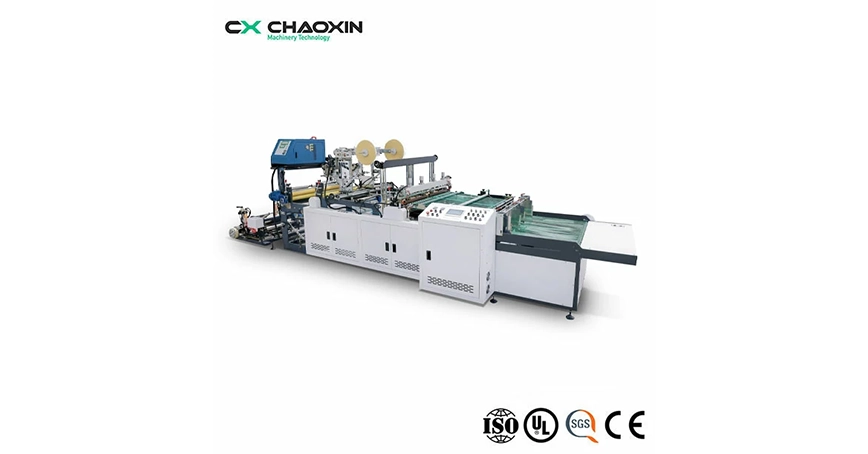
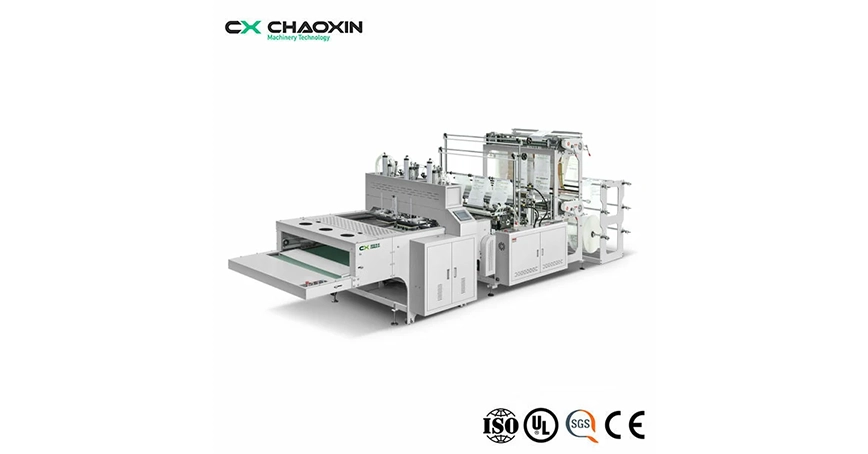
The CX-SB-800 is a single-lane machine running at 200 pcs/min with a maximum bag width of 700mm and a maximum production length of 850mm. The CX-SB-500×2 is a dual-lane machine running at 200×2 pcs/min — two lanes, each producing 200 bags per minute, for a combined output of 400 bags per minute. The dual-lane machine's maximum bag width is 420mm per lane, with a maximum production length of 600mm.
The dual-lane design suits operations that need high output of smaller bags. Courier bags in the 420mm width range are the standard mailer size, and running two lanes doubles throughput without doubling the floor space or the operator headcount.
Both models handle PE and PBAT film in thicknesses from 0.008mm to 0.05mm. PBAT is a biodegradable polyester that's increasingly specified for compostable mailers and eco-conscious packaging. The machine's sealing parameters are adjusted for the film type — PBAT melts at a different temperature than PE, and the hot-bar settings have to match the material.
| Parameter | CX-SB-800 | CX-SB-500×2 |
|---|---|---|
| Suitable materials | PE, PBAT | PE, PBAT |
| Max. bag width | 700mm | 420mm |
| Produce length | 850mm | 600mm |
| Bag making speed | 200 pcs/min | 200×2 pcs/min |
| Film thickness | 0.008–0.05mm | 0.008–0.05mm |
| Total power | 14 kW | 18 kW |
| Dimensions | 5.8×1.1×1.8m | 6.5×1.3×1.8m |
| Weight | 1.5T | 2T |
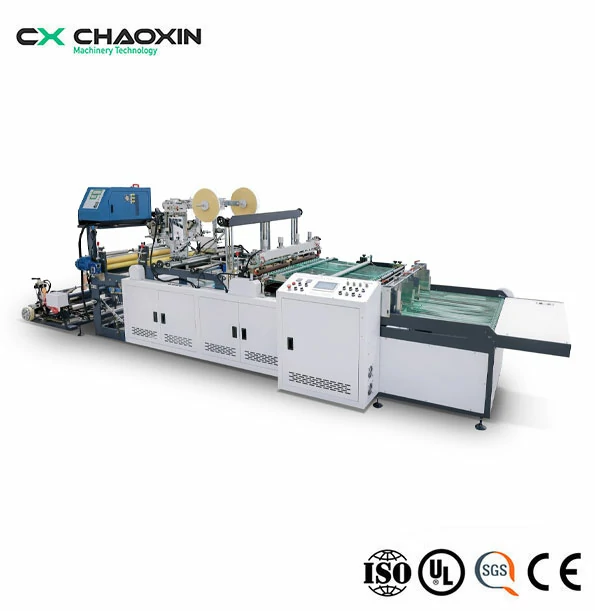
At 200 bags per minute, the film feed has to be precise and repeatable. A servo feeding system controls the film advance, synchronizing the feed with the sealing and cutting cycle. For printed bags, a photoelectric eye reads registration marks on the film and adjusts the feed position so the print stays centered on the finished bag.
That registration control matters for branded courier bags and retail packaging. A bag with an off-center logo or a seam that cuts into the printed area looks like a reject. The photoelectric eye keeps the print-to-seal alignment consistent across the production run.
Film tension affects seal quality. If the film is loose, the folded layers may not align properly at the sealing bar. If the film is too tight, it can stretch or distort. The CX-SB series uses automatic tension control to hold the film at a consistent tension as the roll diameter changes.
The unwind stand includes automatic lifting and edge position control. As the parent roll unwinds and its diameter shrinks, the edge position control keeps the film aligned with the sealing station. That alignment prevents the seam from wandering off the bag edge, which is a common failure mode on side-seal machines when the film tracks poorly.
Side-seal bags are the standard format for courier mailers — the polyethylene bags used by e-commerce and logistics companies to ship apparel, documents, and small parcels. The side seams run along the length of the mailer, and the bag is typically fitted with a self-adhesive strip or a lip-and-tape closure for sealing after packing.
The same machine format also produces bread bags, retail shopping bags, and produce bags. The CX-SB series from Chaoxin is built for these applications, with the CX-SB-800 covering wide bags up to 700mm and the CX-SB-500×2 covering the narrower 420mm format at double output. The machine carries CE certification and a 3-year parts warranty.
Match the machine to your target bag width and output. The CX-SB-800 handles bags up to 700mm wide at 200 pcs/min. The CX-SB-500×2 handles bags up to 420mm wide at 200×2 pcs/min. If your product is a standard courier mailer in the 420mm range and you need high volume, the dual-lane model delivers double throughput in a footprint that's only marginally larger. If you run wider bags — retail shopping bags or large bread bags — the single-lane CX-SB-800 is the right fit.
The CX-SB series runs 0.008mm to 0.05mm film. Thinner films in the 0.008–0.02mm range are used for lightweight mailers and produce bags. Thicker films up to 0.05mm are used for heavier-duty courier bags that need puncture resistance. Confirm that your film supplier can deliver consistent thickness within the machine's range, because thickness variation affects seal temperature and dwell time.
Inspect the sealing bar surface for coating wear or polymer buildup. A contaminated bar transfers uneven heat and produces weak seams. Check the bar's temperature uniformity across its length — a bar that runs hot at one end and cool at the other will produce seals that vary along the bag length. Replace the bar when the coating degrades, and verify the pressure setting against the film thickness.
The CX-SB-800 uses 14 kW total power, and the CX-SB-500×2 uses 18 kW. Confirm the facility's electrical capacity for the combined load, including the starting current of the main motors. The machines run on standard industrial voltage, but the exact supply specification should be confirmed at the ordering stage.
A side-seal bag has two longitudinal seams and a folded bottom edge. A bottom-seal bag has one seam across the bottom and a folded side. Side-seal bags are generally stronger along the length, which is why they're preferred for courier mailers that carry heavier contents. Bottom-seal bags are simpler to produce and are often used for lighter retail packaging.
Yes. The CX-SB series is specified for PE and PBAT. PBAT is a compostable polyester that's used for eco-friendly mailers. The sealing temperature and pressure need to be adjusted for PBAT's melt behavior, which differs from PE. Test the PBAT film on the machine before committing to a full production run, and confirm the gusset and closure specifications with the film supplier.
Side seam leaks usually come from insufficient sealing temperature, low bar pressure, or contaminated film. If the bar is too cool, the polymer doesn't fully melt and the layers don't bond. If the pressure is too low, the melted layers don't consolidate. If the film surface has dust, oil, or moisture, the seal forms over a contaminated interface. Check the bar temperature, the pressure setting, and the film condition before assuming the machine is at fault.
Changing bag size involves adjusting the folding geometry, the sealing bar position, and the cutting length. The servo feed system and the human-machine interface let the operator enter the new dimensions and recall stored parameters. For printed film, the photoelectric registration needs to be re-taught to the new print repeat. Run a few test bags and check the seam strength, the bag dimensions, and the print alignment before resuming full production.
A Side Seal Bag Making Machine should match your bag dimensions, film type, and output target — not the other way around. The CX-SB series from Chaoxin offers the CX-SB-800 for bags up to 700mm wide at 200 pcs/min, and the CX-SB-500×2 for dual-lane production of bags up to 420mm wide at 200×2 pcs/min. Both handle PE and PBAT film in 0.008–0.05mm thickness, with servo feeding, photoelectric registration, and automatic tension control. If you're specifying a line for courier mailers, bread bags, or retail packaging, send us your bag width and film requirements — we'll help you confirm the right model and configuration before you order.
ZHEJIANG CHAOXIN MACHINERY TECHNOLOGY CO., LTD.
Booth No:18.1F20
Time:October 15 – 19, 2026
Add:Canton Fair Complex (Pazhou), Guangzhou
WEB: www.zjchaoxin.com





 English
 Pусский
 Español