Buying Your First Machine?
Call +86-13958915221
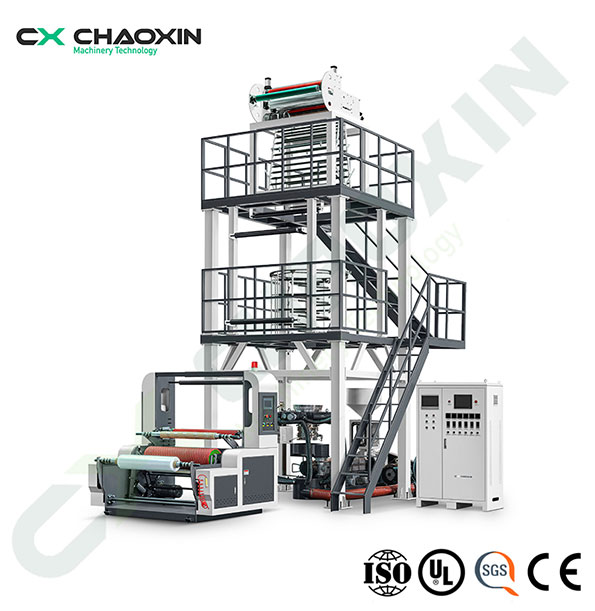
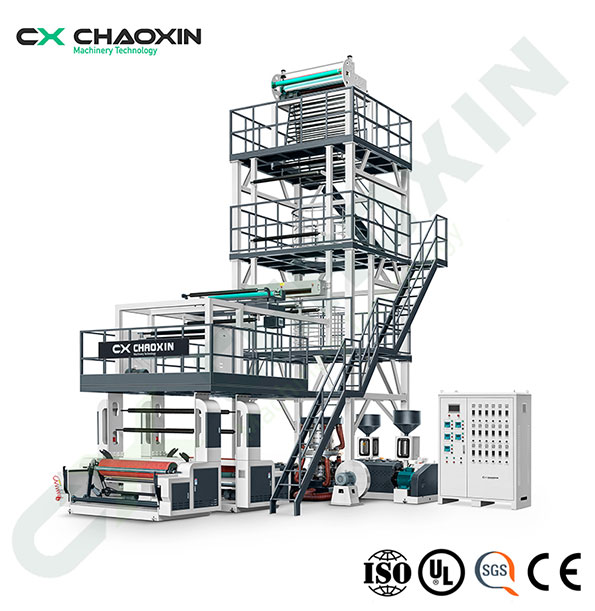
A Multilayer Co-extrusion Film Blowing Machine produces film by inflating a molten tube into a bubble, cooling it, and collapsing it into a lay-flat web. The bubble’s diameter determines the finished film width, so anything that disturbs the bubble shows up as a width variation downstream. You'll see what holds that diameter steady, how the IBC loop responds, and where the CX-1700/2600 sits in output and film thickness.
The lay-flat width is directly related to the bubble diameter—a wider bubble produces a wider film. On a Multilayer Co-extrusion Film Blowing Machine, the extrusion output, the haul-off speed, and the internal air volume all interact to set the bubble size. If the internal air volume drifts, the bubble diameter drifts with it, and the film width drifts at the winder. That’s why the IBC system exists: to hold the air volume at a setpoint rather than letting it wander.
Industry references describe IBC systems using sensors to measure the bubble’s final dimension at or above the frost line, where the film has solidified and the diameter is stable. The control system compares that measurement to the setpoint and adjusts the air flowing into and out of the bubble to bring it back. The page lists an IBC system as part of the CX-1700/2600 configuration, alongside an automatic air ring and a rotary triple-vent air ring. That sensor-and-actuator pair is what turns the bubble from a passive balloon into a controlled dimension.
The IBC loop works on a simple principle: the air entering the bubble must equal the air leaving it, plus whatever is needed to hold the diameter at the setpoint. If the sensor reads the bubble growing, the controller increases exhaust or reduces supply; if it reads the bubble shrinking, the controller does the opposite.
That balance has to act continuously, because the disturbances are continuous. The extruder output fluctuates slightly, the haul-off speed has small variations, and the ambient temperature around the tower changes through the day. The IBC controller’s job is to correct for those disturbances before they show up as film width variation at the winder. Industry descriptions of closed-loop IBC control note that the system measures the tube size and adjusts the air flow to maintain a constant, desired tube size.
| Parameter | CX-75-1700 | CX-95-2200 |
|---|---|---|
| Film width | 1600mm | 2100mm |
| Film thickness | 0.05–0.2mm | 0.05–0.2mm |
| Max. extrusion output | 500kg/h | 680kg/h |
| Screw diameter | Φ60×5 / Φ65×2 | Φ65×6 / Φ70×3 |
| Screw L/D | 32:1 / 30:1 | 32:1 / 30:1 |
| Main motor | 22kW×5 / 30kW×2 | 22kW×6 / 37kW×3 |
| Die diameter | 350mm | 550mm |
| Traction roller width | 1700mm | 2200mm |
| Average power consumption | 420kW | 680kW |
Below the frost line, the film is still molten and the bubble is still expanding. A diameter measured there reflects the forming process, not the finished dimension. Above the frost line, the film has solidified and the bubble has reached its final size. Measuring there gives the controller a stable signal to work from, rather than a value that’s still changing as the film cools.
The IBC holds the bubble diameter; the oscillating tower distributes the thickness variation around the roll. Industry references describe oscillating haul-off units as providing film gauge randomization, which produces wrinkle-free film with more uniform thickness across the web and around the roll. On a multilayer line, that randomization matters because each layer’s thickness contribution is averaged around the circumference rather than concentrated at one angular position.
The CX-1700/2600 combines the IBC bubble control with an oscillating tower. The IBC holds the diameter steady, and the tower rotates the haul-off position so any residual gauge variation is spread evenly. The page lists the oscillation as part of the machine’s tower design, alongside the IBC and the automatic air ring.
IBC: holds bubble diameter by balancing air in and out
Oscillating tower: randomizes gauge around the roll circumference
Automatic air ring: manages external cooling at the die
Rotary triple-vent air ring: distributes external air around the bubble
Gravimetric doser: meters each layer’s material by weight
A single-layer film has one melt stream, so gauge variation comes from the die and the cooling. A multilayer film has several melt streams converging in the die, and each layer can contribute its own thickness variation. The IBC stabilizes the bubble that all the layers share, and the oscillating tower averages the combined variation around the roll. Neither feature alone produces uniform film; together they address the two sources of variation.
The CX-1700/2600 runs two models with different output ceilings. The CX-75-1700 reaches 500kg/h with a 1600mm film width, and the CX-95-2200 reaches 680kg/h with a 2100mm film width. Both run a 0.05–0.2mm film thickness range.
The page lists the suitable materials as LDPE, LLDPE, MLLDPE, EVA, PA, and EVOH. That’s a broad envelope: the polyolefins cover the commodity film range, and PA and EVOH bring barrier properties for multilayer structures. The IBC is what allows those materials to run at the listed output—by cooling the bubble from the inside as well as the outside, it removes heat faster than external cooling alone, which is what supports the 500–680kg/h throughput without the bubble becoming unstable.
The page lists a 32:1 or 30:1 L/D for the screws. A longer screw gives the polymer more residence time for melting and mixing before it reaches the die. On a multilayer line, each extruder has to deliver a consistent melt to its layer channel—if one extruder’s output fluctuates, that layer’s thickness varies, and the IBC can’t correct for a layer-specific variation. The 32:1 L/D option is the one aimed at the more demanding mixing duty.
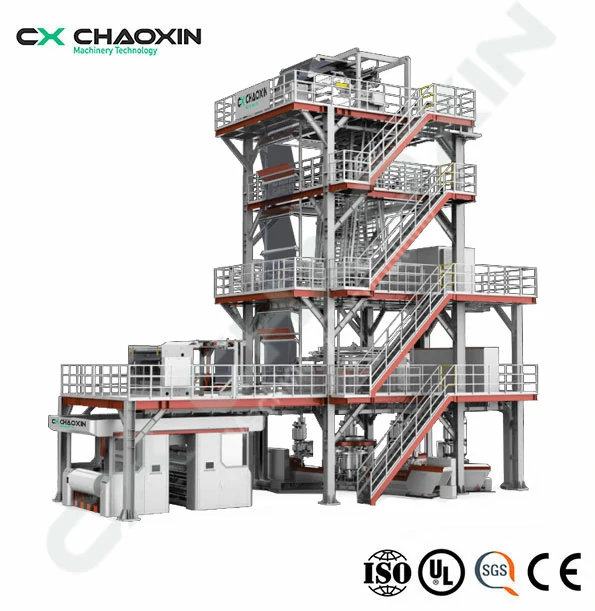
The Multilayer Co-extrusion Film Blowing Machine CX-1700/2600 from CHAOXIN is built around the IBC-controlled bubble the page and its companion configuration describe: a closed-loop air balance that holds the bubble diameter, an oscillating tower that randomizes gauge, a gravimetric doser for each layer, and a 500–680kg/h output across a 0.05–0.2mm thickness range. The suitable materials span LDPE, LLDPE, MLLDPE, EVA, PA, and EVOH, and the CE certification and 3-year parts warranty cover the compliance and service side. For a converter producing barrier film, agricultural film, or packaging film, the value sits in the diameter control—the IBC holds the bubble that sets the finished width, and the oscillating tower spreads the gauge so the roll runs flat through downstream printing and bag-making.
Confirm the film width against the 1600mm or 2100mm model, the thickness against the 0.05–0.2mm range, and the output against the 500kg/h or 680kg/h ceiling. Check the material against the LDPE/LLDPE/MLLDPE/EVA/PA/EVOH list, and the layer structure against the die configuration. The page’s specifications give the starting point; a trial on the actual resin and structure confirms whether the IBC holds the bubble and the tower delivers the flatness at the target output.
Send over your film width, thickness, layer structure, and target output—we'll help you check them against the 1600/2100mm width envelope, the 0.05–0.2mm thickness range, and the 500–680kg/h output ceiling. Talk to CHAOXIN about your Multilayer Co-extrusion Film Blowing Machine requirements and get a line-level answer before you commit to the tower.
ZHEJIANG CHAOXIN MACHINERY TECHNOLOGY CO., LTD.
Booth No:A1-1532
Time:November 17 – 20, 2026
Add:Jl. Gatot Subroto No.1, RT.1/RW.3, Gelora, Kecamatan Tanah Abang, Kota Jakarta Pusat, Daerah Khusus Ibukota Jakarta 10270
WEB: www.zjchaoxin.com





 English
 Pусский
 Español