Buying Your First Machine?
Call +86-13958915221
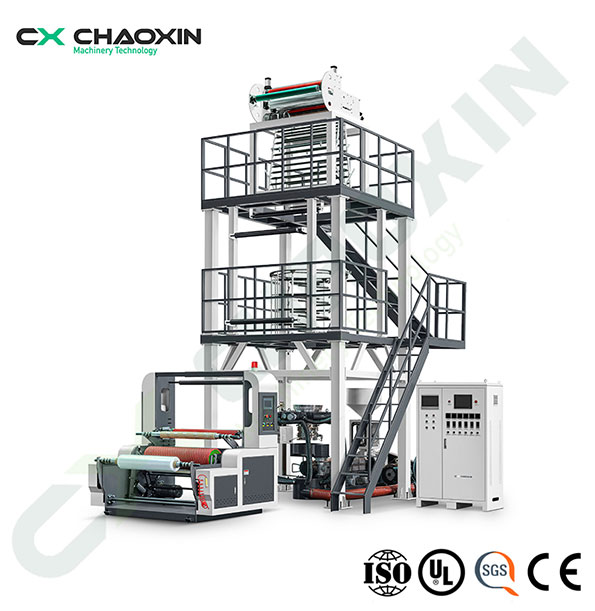
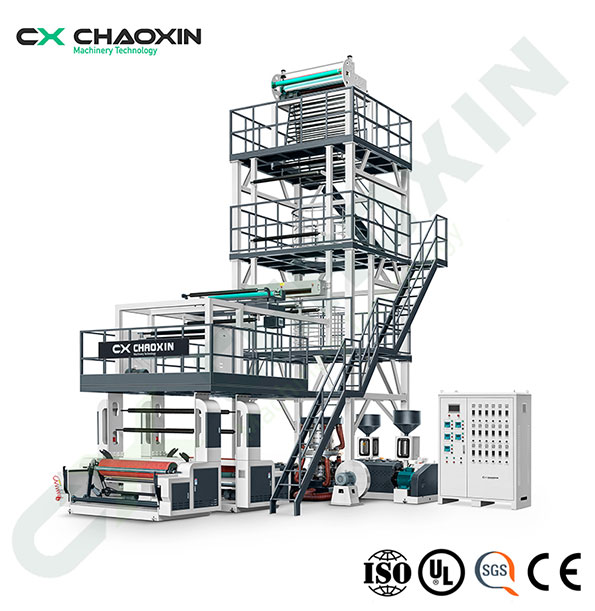
An AB 2Layer Film Blowing Machine does something a single-extruder machine can't: it sends two separate polymer streams into the same die head, so the finished bubble has an A layer and a B layer with independent material choices. You'll see how the two melts are kept apart and joined, what the five-roll traction and PLC winder add, and where the CX-AB series fits a converter's floor.
A single extruder feeds one melt composition into the die. An AB configuration uses two extruders feeding two separate flow channels inside the die head, so the A layer and B layer can be different materials, different colors, or different additive packages. The search results for AB co-extrusion describe this as two extruders entering the same die head to produce a two-layer film, with the die design ensuring clean layer separation. In practice, that means a converter can put a print-ready or seal-ready surface on one layer and a cost-optimized or strength-focused composition on the other, without blending the two into a single homogeneous melt.
The product page lists HDPE, LDPE, and LLDPE as suitable materials for all three CX-AB models. That covers the polyethylene family used in shopping bags, garbage bags, shrink film, agricultural film, express bags, milk bags, and industrial packing film. The two extruders can run the same material in both layers, or split them—HDPE in one layer and LDPE in the other, for example—depending on the film property the job requires.
The die head is where the AB split happens. Each extruder delivers its melt to a separate annular channel, and the two streams converge at the die exit to form a single bubble with an inner layer and an outer layer. The page describes the die head as variable-frequency controlled with adjustable rotation speed, so the operator can tune the die speed to match the production rate and the raw material's flow behavior.
The layer ratio is set by the relative output of the two extruders, not by a mechanical divider inside the die. That's why the screw diameter and the gravimetric doser matter: the screws determine the maximum output from each side, and the doser controls how much material actually reaches the die per unit time. The page lists the CX-AB-700 with 45mm×2 screws and a 32:1/30:1 L/D ratio, stepping up to 50mm×2 on the CX-AB-900 and 55mm×2/50mm×2 on the CX-AB-1100.
A longer screw L/D gives the polymer more residence time for melting and mixing before it reaches the die. The page lists 32:1 and 30:1 options with bimetallic screw construction, described as providing stronger plasticizing capacity and wear resistance. For an AB configuration, consistent melt quality on each side is what keeps the layer boundary stable—if one extruder delivers unmelted or unevenly mixed material, the layer thickness will vary across the bubble.
The page describes the automatic winder as equipped with a patented five-roll traction system: traction roll, embossing roll, rubber roll, cooling water roll, and polyurethane roll. Compared with three-roll or four-roll designs, the two extra rolls—the curved roll and the cooling water roll—are standard on this machine, and the page states they deliver flatter film quality.
The cooling water roll is the component that matters for film flatness and transparency. A film that's still warm when it reaches the winder can block or wrinkle as it's wound. Running the film over a chilled roll before the nip removes that heat and sets the film's dimensional state before winding. The PLC winder then controls the winding tension and roll build, with the page noting solid-state relays, PLC, and internationally branded switches supporting continuous non-stop operation.
| Parameter | CX-AB-700 | CX-AB-900 | CX-AB-1100 |
|---|---|---|---|
| Film width | 100–600mm | 400–800mm | 500–1000mm |
| Film thickness | 0.006–0.10mm | 0.006–0.10mm | 0.006–0.10mm |
| Screw diameter | 45mm×2 | 50mm×2 | 55mm×2 / 50mm×2 |
| Screw L/D | 32:1 / 30:1 | 32:1 / 30:1 | 32:1 / 30:1 |
| Max. output (HDPE) | 70kg/h | 85kg/h | 100kg/h |
| Max. output (LDPE) | 85kg/h | 100kg/h | 120kg/h |
| Main motor | 15KW×2 | 15KW×2 | 18.5KW×2 |
| Average power | 25KW | 28KW | 32KW |
The HDPE and LDPE output figures are listed separately because the two materials process differently. HDPE has a higher melting point and a narrower processing window than LDPE, so the maximum extrusion rate is lower for HDPE on the same screw. When the two extruders run different materials in an AB split, the layer ratio has to respect both sides' maximum outputs—you can't pull 100kg/h of HDPE from a 45mm screw that's rated for 70kg/h, regardless of what the other side delivers.
The page lists a DEFINITI gravimetric doser as standard equipment, described as providing higher metering accuracy and longer service life. A gravimetric doser weighs the material as it feeds, rather than controlling by volume, so the output is held to a weight-per-hour setpoint. Industry references for gravimetric dosing in extrusion list recipe accuracy in the range of ±0.1% to ±0.3% depending on the system. For an AB line, that accuracy is what keeps the layer ratio consistent from roll to roll.
The air ring is listed as a patented dual air outlet design with independent nozzles. Stable and large air volume improves film cooling performance and raises output capacity. On a two-layer bubble, the outside layer cools first as it contacts the air ring's flow; a stable air pattern keeps the frost line at a consistent height, which is what holds the bubble diameter steady.
Gravimetric doser: weight-based feed control for layer ratio consistency
Dual-outlet air ring: stable bubble cooling and frost line height
Bimetallic screws: 30:1/32:1 L/D for plasticizing and wear resistance
Five-roll traction: includes cooling water roll and curved roll for flatness
PLC winder: tension control and continuous operation
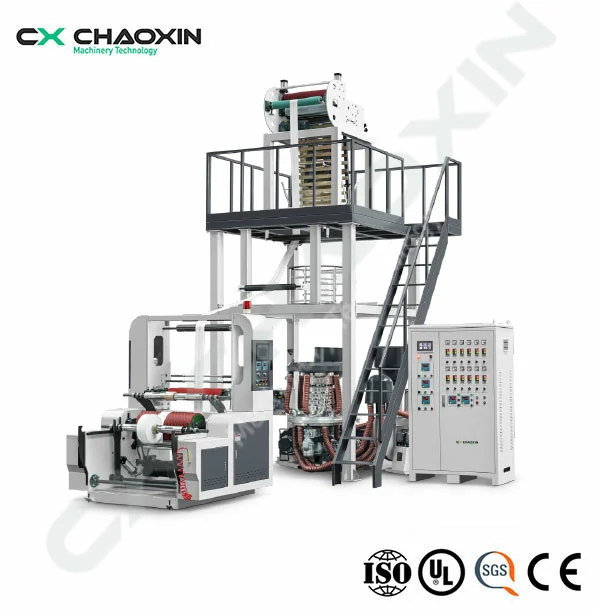
The AB HDPE/LDPE High Speed Automatic Film Blowing Machine from CHAOXIN is built around the two-extruder architecture the page describes: 45mm×2 to 55mm×2 bimetallic screws, a variable-frequency die head, DEFINITI gravimetric dosing, a patented five-roll traction system, and a PLC winder. The three models cover film widths from 100–600mm on the CX-AB-700 up to 500–1000mm on the CX-AB-1100, with HDPE outputs from 70kg/h to 100kg/h and LDPE outputs from 85kg/h to 120kg/h. For a converter producing shopping bags, garbage bags, or industrial packing film, the AB 2Layer Film Blowing Machine value sits in the material split—the A and B layers can carry different compositions without a separate lamination step, and the five-roll traction with the cooling water roll addresses the film flatness that downstream printing and bag-making operations depend on.
Confirm the film width against the model's range, the layer ratio against the two screws' output limits, and the film thickness against the 0.006–0.10mm envelope. The page's output figures are maximums for each material—a job that runs both extruders at their ceiling simultaneously may be limited by the lower-rated side. A trial on the actual resin and layer split is the step that confirms the bubble stability and film flatness hold at the target rate.
Send over your film width, layer ratio, and target output—we'll help you check them against the CX-AB-700's 45mm×2 screws, the CX-AB-900's 50mm×2, or the CX-AB-1100's 55mm×2/50mm×2 configuration. Talk to CHAOXIN about your AB 2Layer Film Blowing Machine requirements and get a model-level answer before you commit to the line.
ZHEJIANG CHAOXIN MACHINERY TECHNOLOGY CO., LTD.
Booth No:A1-1532
Time:November 17 – 20, 2026
Add:Jl. Gatot Subroto No.1, RT.1/RW.3, Gelora, Kecamatan Tanah Abang, Kota Jakarta Pusat, Daerah Khusus Ibukota Jakarta 10270
WEB: www.zjchaoxin.com





 English
 Pусский
 Español