Buying Your First Machine?
Call +86-13958915221
You're producing agricultural mulching film — the thin plastic sheet that covers soil to retain moisture, suppress weeds, and warm the ground for early planting. The film has to be thin enough to conform to the soil surface, strong enough to survive field installation, and wide enough to cover the bed in one pass. An AB 2Layer Film Blowing Machine produces that film by extruding two layers of molten plastic through a circular die, inflating the bubble, and winding the cooled film into rolls. This article explains how the dual-screw configuration works, what materials the machine handles, and how to match the film dimensions to your mulching application.
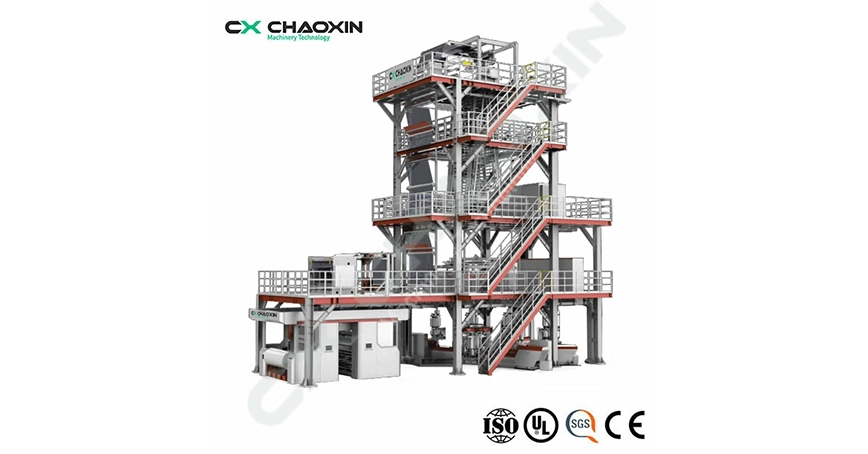
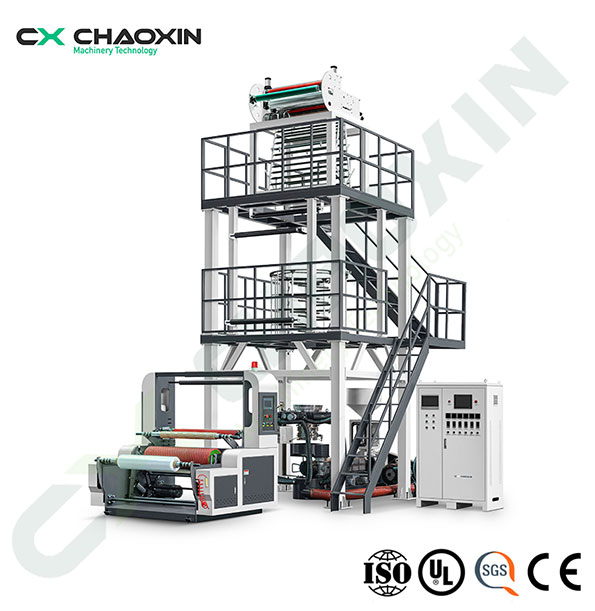
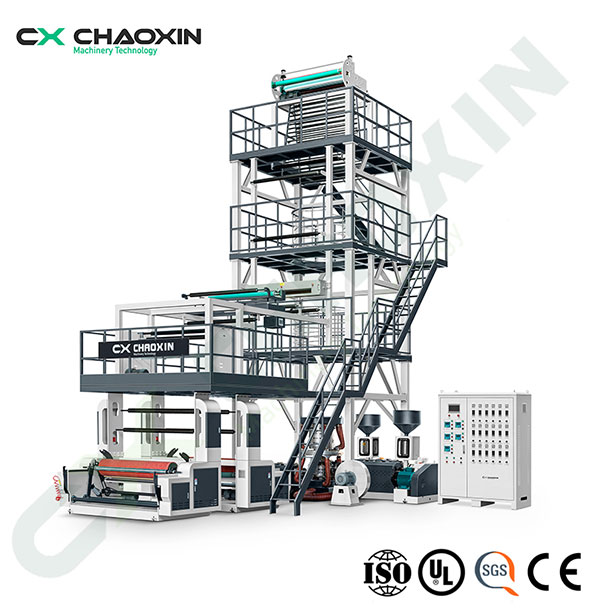
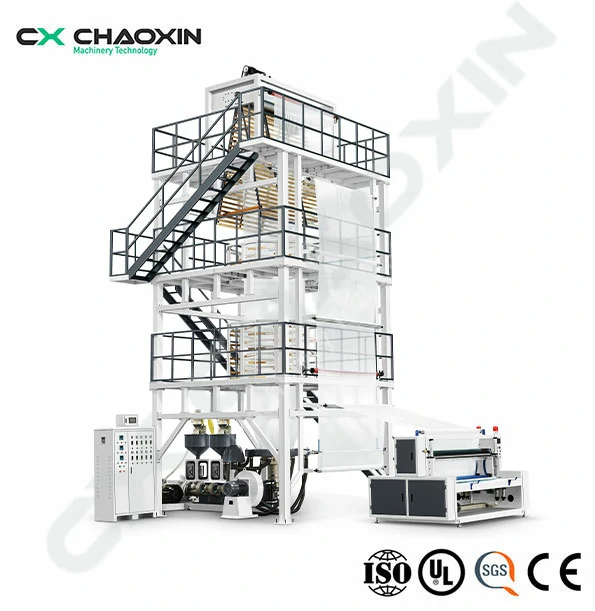
An AB two-layer film blowing machine uses two extruders feeding a single die head. The A layer and B layer come from separate screws, and the die head combines them into a two-layer film structure. The CX-1300AB, CX-1700AB, and CX-2200AB models all use this dual-screw design with screw diameters of 60mm × 2, 65mm × 2, and 70mm × 2 respectively.
The screw L/D ratio is 32:1 or 30:1, which gives the screws enough length to fully melt and homogenize the polymer before it reaches the die. A longer screw means more residence time in the barrel, which translates to better mixing and more consistent melt quality. For mulch film production, that consistency shows up as uniform film thickness and fewer weak spots that tear during field installation.
The molten plastic exits the circular die and is inflated into a bubble by air pressure. The bubble rises through the machine, cooling as it goes, until it reaches the traction rollers that collapse it into a flat film. The die diameter varies by model: 250mm on the CX-1300AB, 350mm on the CX-1700AB, and 500mm on the CX-2200AB. A larger die produces a larger bubble, which translates to a wider film.
The cooling process determines the film's transparency and strength. The air ring that surrounds the die controls the cooling air volume and velocity. The AB series uses a structurally optimized high-speed air ring that reduces wind resistance and makes the change of air volume gentle, which helps maintain a stable bubble and consistent film properties.
The CX-AB series handles LDPE, LLDPE, and PBAT as suitable materials. LDPE and LLDPE are the standard polyolefins for agricultural film — they're flexible, durable, and resist UV degradation when properly stabilized. PBAT is a biodegradable polyester that lets you produce mulch film that breaks down in the field rather than persisting in the soil.
The material choice affects the processing parameters. LDPE and LLDPE run at similar temperature profiles, but PBAT requires different melt temperatures and may need a different screw configuration to avoid degradation. If you're planning to run biodegradable mulch film, verify with the machine supplier that the screw and die are configured for PBAT processing.
Maximum extrusion output ranges from 150kg/h to 260kg/h depending on the model and the material being run. The CX-1300AB produces 150kg/h on one configuration and 180kg/h on another; the CX-2200AB reaches 220kg/h to 260kg/h. Those output rates scale with the screw diameter and the film width — wider film means more material processed per hour.
| Model | CX-1300AB | CX-1700AB | CX-2200AB |
|---|---|---|---|
| Suitable materials | LDPE, LLDPE, PBAT | LDPE, LLDPE, PBAT | LDPE, LLDPE, PBAT |
| Film width | 800-1200mm | 1000-1600mm | 1200-2100mm |
| Film thickness | 0.006-0.03mm | 0.006-0.03mm | 0.006-0.03mm |
| Max. extrusion output | 150kg/180kg | 160kg/200kg | 220kg/260kg |
| Screw diameter | 60mm × 2 | 65mm × 2 | 70mm × 2 |
| Screw L/D | 32:1 / 30:1 | 32:1 / 30:1 | 32:1 / 30:1 |
| Main motor | 22kW × 2 | 30kW × 2 | 37kW × 2 |
| Average power consumption | 45kW | 55kW | 65kW |
| Die diameter | 250mm | 350mm | 500mm |
| Traction roller width | 1300mm | 1700mm | 2200mm |
Mulch film is thin — 0.006mm to 0.03mm — and thin film amplifies any instability in the traction system. If the traction rollers don't pull the film evenly, the bubble wobbles, the film thickness varies, and the wound roll develops wrinkles that cause problems during field installation.
The AB series uses a five-roller traction system with one embossing roller, one bending roller, one polyurethane roller, and two traction rollers. That roller arrangement provides more contact points and better grip on the film than a three-roller or four-roller system, which translates to more stable traction and flatter film.
The cold water roller is a component that rapidly reduces the film temperature after it leaves the bubble. Faster cooling improves film transparency and reduces adhesion between layers in the wound roll. For mulch film, better transparency means better light transmission to the soil, which affects soil warming and weed suppression. And reduced adhesion means the roll unwinds cleanly in the field instead of sticking to itself.
Agricultural mulching film is used across a range of crops — vegetables, fruits, grains, and specialty plantings. The film covers the soil surface to reduce moisture evaporation, maintain soil temperature, suppress weed growth, and protect the plant base from soil-borne pests. The two-layer AB structure gives you the option to use different materials in each layer: a UV-stabilized outer layer for sunlight resistance and a tougher inner layer for puncture resistance.
The film width options cover different bed configurations. 800-1200mm works for narrow beds and small-scale plantings; 1200-2100mm covers wider beds and larger field operations. The traction roller width matches the film width range, so the machine can run the full width without the film wandering off the rollers.
PBAT mulch film is a biodegradable alternative to conventional polyethylene. It breaks down in the soil after the growing season, eliminating the labor and waste disposal costs of collecting and removing plastic film from the field. The AB two-layer configuration lets you produce a film with a PBAT core and a stabilizing outer layer, or a full PBAT structure depending on the degradation timeline you need. An AB 2Layer Film Blowing Machine like the CX-AB series from Chaoxin is built for this kind of production, with dual screws that can be configured for different material combinations.
The model number corresponds to the traction roller width: 1300mm, 1700mm, or 2200mm. Film width ranges are 800-1200mm, 1000-1600mm, and 1200-2100mm respectively. Choose the model that covers your target film width without running at the extreme edge of the range. If your primary product is 1,200mm mulch film, the CX-1700AB gives you margin on both sides; the CX-1300AB would be running at its maximum.
The machine handles 0.006mm to 0.03mm film thickness across all three models. Conventional mulch film typically runs at the thinner end of that range, around 0.008-0.015mm, to balance material cost with mechanical strength. Thicker films resist puncture better but cost more per square meter. The two-layer structure lets you put more material where it's needed — a thinner outer layer and a slightly thicker inner layer, for example.
Average power consumption is 45kW for the CX-1300AB, 55kW for the CX-1700AB, and 65kW for the CX-2200AB. The main motors are 22kW × 2, 30kW × 2, and 37kW × 2 respectively. Check your facility's electrical capacity against these figures before selecting a model. The motors use frequency conversion, which helps manage the starting current and reduces energy consumption during operation.
Film thickness consistency depends on stable bubble inflation and consistent traction. The air ring's high-speed design keeps the cooling air uniform around the bubble circumference. The traction rollers maintain constant tension on the collapsed film. And the screw's melt quality determines whether the extrudate flows evenly through the die. If you see thickness variation, check the air ring for obstructions, verify the traction roller pressure, and inspect the die for partial blockage.
An AB 2Layer Film Blowing Machine should match your target film width, material type, and output requirement — not the other way around. The CX-1300AB, CX-1700AB, and CX-2200AB from Chaoxin handle LDPE, LLDPE, and PBAT at outputs from 150kg/h to 260kg/h, with film widths from 800mm to 2100mm and thickness from 0.006mm to 0.03mm. The dual-screw design, five-roller traction system, and high-speed air ring work together to produce thin mulch film with consistent thickness and flat winding. If you're specifying a blown film line for agricultural mulching film or biodegradable film production, send us your film width and material requirements — we'll help you confirm the right model and configuration before you order.
ZHEJIANG CHAOXIN MACHINERY TECHNOLOGY CO., LTD.
Booth No:18.1F20
Time:October 15 – 19, 2026
Add:Canton Fair Complex (Pazhou), Guangzhou
WEB: www.zjchaoxin.com





 English
 Pусский
 Español