Buying Your First Machine?
Call +86-13958915221
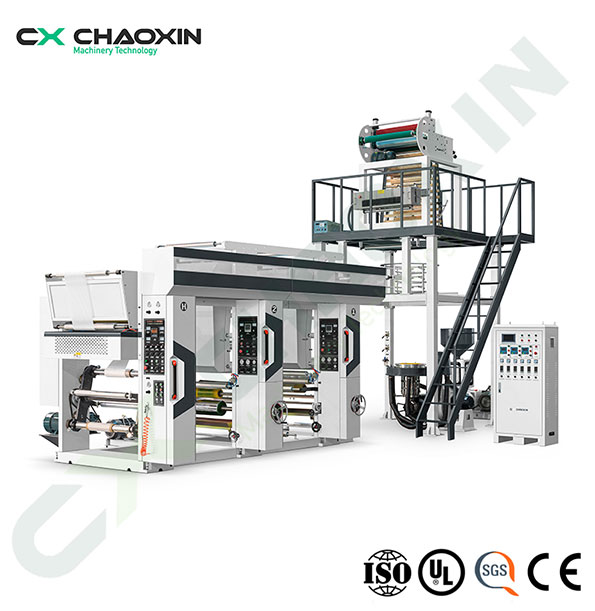
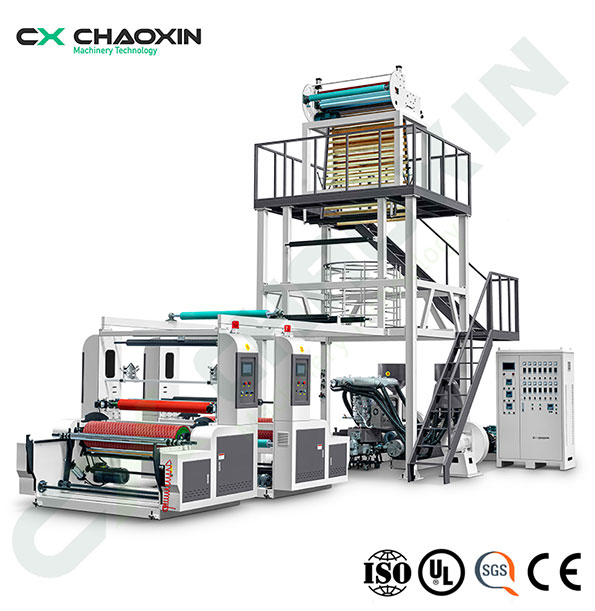
Biodegradable resins are not PE. They have a narrower melting window, higher moisture sensitivity, and lower melt strength. A standard biodegradable blown film machine modified with a few adjustments will not cut it. You need equipment designed from the screw up for these materials. This guide explains what makes PLA and PBAT different, what a biodegradable blown film line must include, and how one Chinese manufacturer has adapted its extruders to run compostable resins without the usual headaches.
Processing PLA and PBAT is technically harder than processing polyethylene. Here is why.
PE melts over a wide range (typically 160–220°C). PLA melts around 150–170°C. PBAT is similar. But if you go just 10–15°C above that range, the polymer chains degrade. The material becomes brittle, and the film loses mechanical strength. Go too low, and the melt is inconsistent, leading to poor bubble stability.
Many standard extruders have temperature controllers that drift by ±5°C. That range is acceptable for PE. For biodegradable resins, it is a disaster.
PLA and PBAT are hygroscopic. They absorb moisture from the air. If the pellets are not dried properly, moisture turns to steam inside the barrel, creating bubbles in the melt. Those bubbles cause pinholes and weak spots in the film. In severe cases, the bubble collapses entirely.
PE has high melt strength. The bubble stands tall and resists stretching. PLA and PBAT have much lower melt strength. The bubble wobbles, sags, and tears easily. You need better cooling and more precise air ring control to stabilize it.
Biodegradable resins degrade under high shear. A screw designed for high‑output PE will generate too much friction, overheating the polymer and causing degradation. You need a screw with gentler mixing and a lower compression ratio.
A biodegradable blown film machine that ignores these four factors will produce scrap, not saleable film.
Here are the modifications that separate a dedicated compostable film line from a retrofitted PE line.
Standard temperature controllers (±5°C) are not good enough. A biodegradable blown film machine for PLA/PBAT needs ±0.5°C accuracy. This requires PID controllers with high‑resolution thermocouples and well‑insulated heating zones.
Chaoxin uses German‑spec temperature modules that maintain melt temperature within ±0.5°C. This stability prevents degradation and ensures consistent melt flow.
The screw is the heart of any extruder. For biodegradable resins, you need a screw with:
Lower compression ratio – typically 2.5:1 or 3:1 instead of 3.5:1 for PE
Gentle mixing sections – no aggressive Maddock or pineapple mixers
Wear‑resistant alloys – PLA and PBAT can be abrasive, especially with mineral fillers
Chaoxin has developed proprietary screw designs for PLA, PBAT, and starch‑based blends. Their lab has tested over 6,800 formulations, so they do not guess. They match the screw to the material.
PLA pellets must be dried to below 250 ppm moisture before extrusion. A biodegradable blown film line should include or integrate with a desiccant dryer. Without it, you will fight pinholes and bubble breaks.
Pure PLA is brittle. PBAT is flexible but offers poor barrier properties. The best compostable films combine materials: a PBAT layer for flexibility, a PLA layer for stiffness, and sometimes a starch‑based layer for cost reduction.
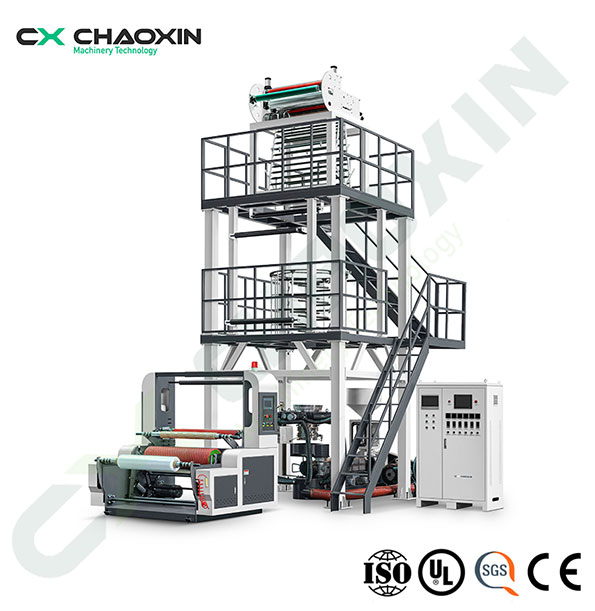
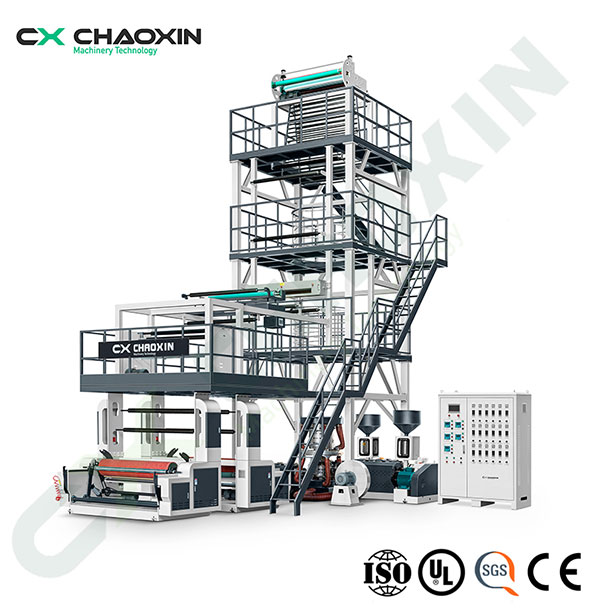
A three‑layer or ABA co‑extrusion line allows you to engineer the film properties. For example, an ABA structure with PLA on the outside and PBAT in the middle gives you stiffness, tear resistance, and compostability.
A biodegradable blown film machine with co‑extrusion capability lets you formulate films for specific applications, not just one generic grade.
Chaoxin publishes specific data for its biodegradable blown film lines.
The thickness tolerance is controlled within 0.006–0.04mm. For comparison, many commodity PE lines operate at ±0.01–0.02mm. Tighter thickness control is critical for biodegradable films because the lower melt strength amplifies any gauge variation.
Chaoxin cites that films produced on its equipment show 35% higher tensile strength and 28% higher tear strength compared to standard equipment. These numbers come from actual material tests, not theoretical calculations.
For agricultural applications, the company reports that its biodegradable film retained 92% of its original tensile strength after 90 days in field conditions. That is sufficient to cover a full crop cycle.
Thanks to real‑time thickness monitoring and automatic tension adjustment, Chaoxin claims a finished product yield rate of up to 99%. In practice, this means fewer rejects, less material waste, and lower operating costs.
Chaoxin’s intelligent temperature control maintains the melt within the narrow window required for PLA and PBAT. One customer reported a 40% reduction in production downtime and a 25% increase in output after switching to Chaoxin equipment.
A biodegradable blown film machine (fourth mention) with these specifications will run 24/7 without constant babysitting. ← 主词第4次(加粗)
Chaoxin’s biodegradable blown film machines support a wide range of eco‑friendly materials:
Polylactic acid (PLA) – derived from corn starch, rigid, good clarity
Polybutylene adipate terephthalate (PBAT) – flexible, tough, compostable
Starch‑based materials – low cost, blends with PLA/PBAT
Fiber‑based surface materials – specialty applications
Hybrid materials – custom blends for specific property requirements
The equipment also passes ISO, UL, SGS, and CE certifications – not a minor detail for exporters shipping to Europe or North America.
The market for compostable packaging and agricultural film is growing, but it remains a segment for producers who can control quality. A film that tears during application or fails to degrade on schedule will not retain customers.
The key is to match the material and the machine to the application:
| Application | Recommended structure | Key requirement |
|---|---|---|
| Shopping bags | PBAT/PLA blend + starch | Tear resistance, printability |
| Agricultural mulch | ABA, PLA outer / PBAT core | UV stability, controlled degradation |
| Food packaging | 3‑layer, PLA/EVOH/PLA | Oxygen barrier, heat sealability |
| Compostable liners | Single‑layer PBAT | Flexibility, wet strength |
A biodegradable blown film machine that can switch between these structures without major retooling is the one that pays for itself.
Chaoxin has been building blown film lines for decades. Their biodegradable blown film machines are not retrofits. They are purpose‑built with:
German‑spec ±0.5°C temperature modules
Self‑developed low‑shear screws for PLA and PBAT
Multi‑layer co‑extrusion (ABA, 3‑layer)
Real‑time thickness monitoring with automatic adjustment
Dual‑air‑ring cooling for bubble stability
According to internal customer data from Chaoxin, 95% of clients report high satisfaction with the equipment’s performance in biodegradable film production. One organic farming cooperative reported that switching to Chaoxin‑made biodegradable agricultural film increased lettuce yields by 39% while reducing microplastic contamination in soil by 80%.
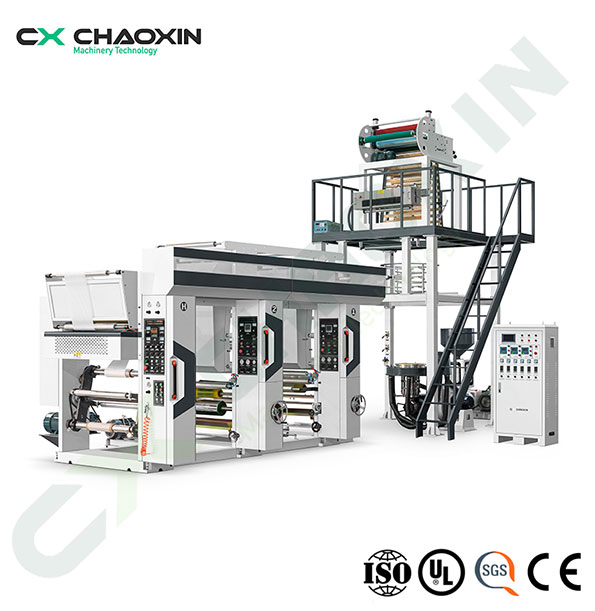
You do not need to guess if a machine can handle your PLA or PBAT blend. Chaoxin can arrange a trial run at their facility using your pellets. You will see the bubble stability, measure the thickness variation, and test the film strength.
A biodegradable blown film machine that is built for the material, not adapted from a PE line, will save you months of troubleshooting and thousands in scrap.
ZHEJIANG CHAOXIN MACHINERY TECHNOLOGY CO., LTD.
Booth No:18.1F20
Time:October 15 – 19, 2026
Add:Canton Fair Complex (Pazhou), Guangzhou
WEB: www.zjchaoxin.com





 English
 Pусский
 Español