Buying Your First Machine?
Call +86-13958915221
You are running a single‑layer blown film line. Your material cost is high because every kilogram of film uses virgin resin. You want to add recycled material, but it affects surface appearance and seal strength. You consider a three‑layer ABC line, but three extruders mean higher investment, more floor space, and greater complexity. An ABA blown film machine offers a different approach.
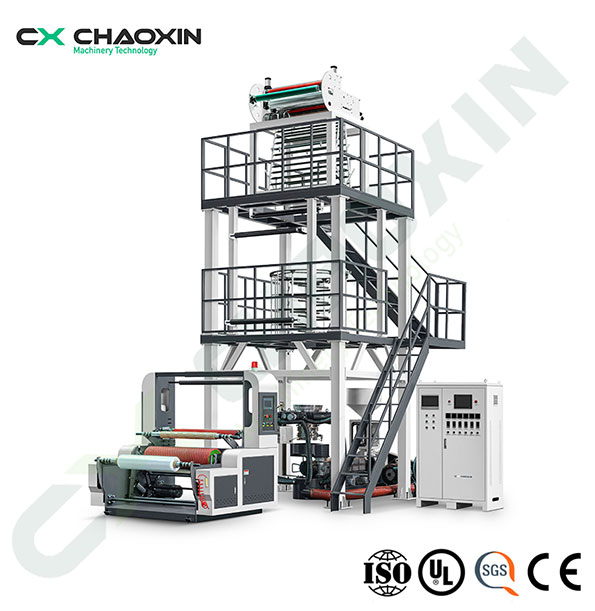
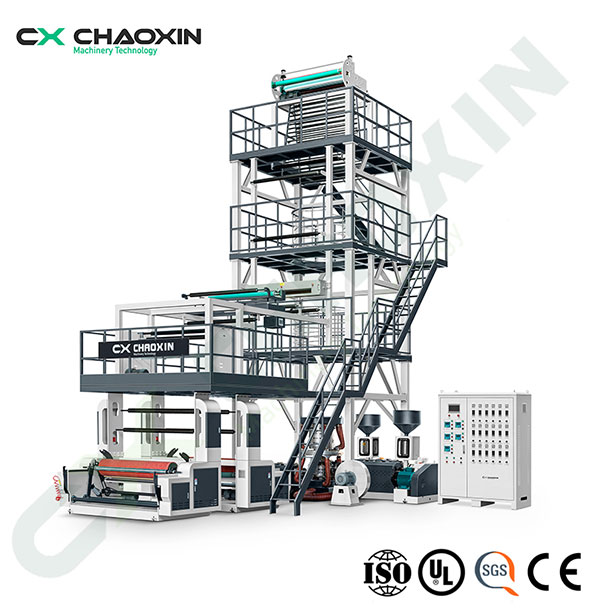
With two extruders and a specially designed die head, it produces a symmetrical three‑layer film: two outer layers (A) of the same material, and a thick core layer (B) that can be completely different. The core can take recycled pellets, calcium carbonate filler, or a lower‑grade resin, while the thin outer layers preserve the finish, printability, and mechanical performance customers demand. This combination has made ABA lines a standard for high‑volume commodity film production. This guide explains how ABA works, where it saves money, and when it might – or might not – be the right choice for your operation.
The naming tells you the structure. A‑B‑A means the two outer layers are the same material; the middle layer can be something else.
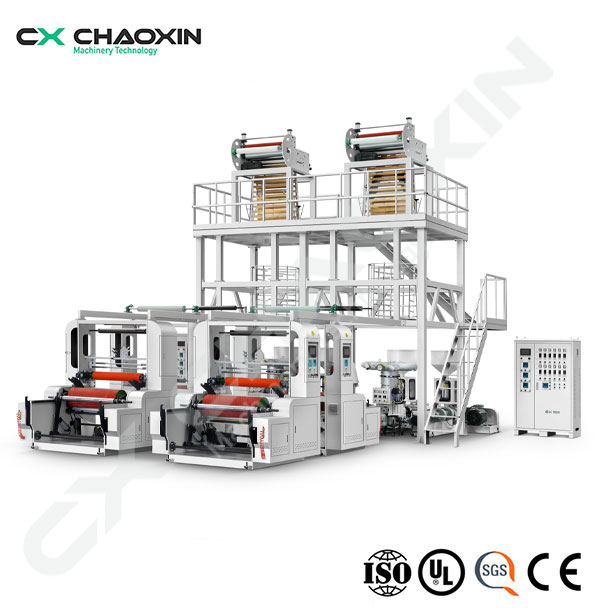
An ABA line uses two extruders. A larger extruder feeds the B (core) layer, which can make up 50–75% of the total film thickness. A smaller extruder splits its output to supply both outer A layers via flow channels inside the die head. The result is a three‑layer film from only two extruders.
Compared to a full ABC machine that requires three extruders, an ABA line typically costs less to buy, uses less electricity, and occupies less floor space. Compared to mono‑layer, ABA offers the ability to hide recycled or low‑cost material in the core without compromising surface quality.
The economic case for an ABA line rests on one figure: how much of the film can be non‑virgin material.
| Layer | Typical share of total thickness | Material type |
|---|---|---|
| Outer A (both sides) | 15–25% each | Virgin resin (HDPE, LDPE, LLDPE) |
| Core B | 50–70% | Recycled material, CaCO₃, lower‑grade resin |
A typical configuration puts 30% of the material in the outer layers and 70% in the core. If the core uses 100% recycled pellets or a 60% calcium carbonate compound, the overall virgin resin consumption drops by more than half. For a plant running 500 tons per month, that difference quickly adds up.
A ABA blown film machine keeps the surface layers clean and printable. The core does the heavy work of providing bulk and stiffness while using cheap input.
Not every material works in every application, but ABA machines are designed for flexibility.
Recycled HDPE or LDPE: Many operators run up to 100% recycled material in the core. The outer virgin layers cover any discoloration or odor from the recyclate.
Calcium carbonate (CaCO₃): Filler can be added at 30–60%. It lowers cost, increases stiffness, and reduces shrinkage. The outer layers protect print adhesion.
Biodegradable resins (PLA, PBAT): The core can take a lower‑grade biopolymer while the outer layers use a higher‑grade material with better sealing properties.
Lower‑MFI resin: A cheaper resin with a different melt index can sit in the core without disturbing bubble stability.
A successful Turkish converter was able to achieve a 1:11:1 layer ratio with ABA technology, drastically reducing material cost while maintaining consistent film quality. Their existing equipment could not reach the same ratio, leading to production delays. After switching to an ABA line with advanced die‑head control, they cut costs and improved consistency.
There is a persistent belief that ABA film is weaker than mono‑layer. Industry data shows the opposite.
Reports indicate that a three‑layer ABA film can be up to 30% stronger than a single‑layer film of the same thickness. The reason is straightforward: the interface between layers resists crack propagation. A mono‑layer film tears straight through. An ABA film has to tear through one outer layer, then the core, then the other outer layer – each interface stops or deflects the crack.
For shopping bags, garbage bags, and shrink film, that extra strength allows downgauging. If a single‑layer bag needs 50 microns to pass a drop test, an ABA bag can sometimes run at 40 microns while meeting the same spec. Downgauging saves material cost across the entire weight of the film, not just in the core.
A ABA blown film machine producing T‑shirt bags or courier envelopes can deliver the same performance with lower material consumption.
ABA structures are most common in applications where surface appearance matters but core cost matters more.
| Product | Why ABA fits |
|---|---|
| T‑shirt shopping bags | Outer layer prints cleanly; core takes recycled PE or CaCO₃ |
| Garbage bags on a roll | Core uses up to 60% filler; tear strength remains high |
| Courier / express envelopes | Puncture‑resistant outer protects internal documents |
| Shrink film for bundled goods | Stiff core provides holding force |
| Agricultural mulch film (basic grade) | UV stabiliser only needed in thin outer layers |
For food packaging that requires an oxygen barrier or a dedicated seal layer, an ABC three‑extruder line is usually necessary. But for the majority of high‑volume commodity film, ABA dominates.
Running a high core percentage – especially with recycled material or filler – places demands on the extruder and die.
The core extruder needs a screw that handles contamination, irregular melt flow, and high filler content. Cheap screws wear quickly when running CaCO₃ or regrind. Chaoxin uses self‑developed double alloy screws with 30:1 or 32:1 L/D ratios specifically formulated for recycled and filled materials.
An ABA die head must split the small extruder’s output evenly to both outer layers. Uneven distribution causes thickness variation and weak spots. Good ABA dies use advanced flow channels with precise temperature zoning to maintain balance.
HDPE requires rapid quenching. LLDPE runs softer. The cooling system must handle variable core compositions while keeping the bubble centred. Chaoxin’s lines use dual air rings with independent temperature control on each ring.
A ABA blown film machine equipped with a properly designed die head and screw will run for years without excessive maintenance.
Chaoxin has been building blown film lines for decades. Their ABA models are part of a complete range that includes mono‑layer, AB, ABC, and five‑layer systems.
Key features across their ABA lines include:
Five‑roller traction for consistent flatness and tension control
Omron temperature control with cast aluminum heaters for even heating
Siemens, GE, or Brook motors and Delta or ABB inverters
Three‑year warranty on core components – screw, barrel, gearbox
6S management on the factory floor – clean, organised assembly
Chaoxin’s ABA machines are available in multiple die widths, with output capacities ranging from 120 kg/h to over 500 kg/h. They export to more than 30 countries.
| Feature | ABA | ABC |
|---|---|---|
| Number of extruders | 2 | 3 |
| Outer layer material | Same on both sides | Can be different |
| Core material | Recycled, filler, lower grade | Barrier resin (EVOH), high‑grade |
| Best for | Cost‑sensitive commodity film | High‑performance barrier film |
| Investment cost | Lower | Higher |
| Energy consumption | Lower | Higher |
For a producer focused on shopping bags, garbage bags, and agricultural film, ABA is often the more economical choice. If the application requires asymmetrical properties – for example, a heat‑sealable inner layer and an abrasion‑resistant outer – ABC is necessary.
One converter in Turkey needed a 1:11:1 layer ratio for their ABA film to reduce material cost while maintaining durability. Their earlier equipment could not hold the ratio consistently, causing thickness variation and production delays. After working with a manufacturer to adjust machine settings and provide on‑site training, they achieved stable production and a significant reduction in material cost. The partnership has since continued with repeat orders.
Industry data also indicates that 95% of clients using well‑configured ABA lines report high satisfaction with equipment performance, particularly for high‑output commodity film production.
Do not guess whether ABA fits your production. Calculate your current virgin resin consumption. Estimate how much of the core could be replaced with recycled material or filler. Then ask for a trial run.
A ABA blown film machine that matches your material blend and target output will pay for itself faster than a mono‑layer line could ever compete.
ZHEJIANG CHAOXIN MACHINERY TECHNOLOGY CO., LTD.
Booth No:18.1F20
Time:October 15 – 19, 2026
Add:Canton Fair Complex (Pazhou), Guangzhou
WEB: www.zjchaoxin.com





 English
 Pусский
 Español